Cameronian scoops top prize at Bisley
This fascinating photograph is contained within an old album in the regimental collection. It shows Private Brown of B Company, 1st Battalion The Cameronians – winner of the Imperial Prize competition at Bisley in 1894. The rather impressive silverware next to him are the challenge vases awarded as part of the prize; the other part being a personal cheque of £100 – a fair old sum for a Private soldier in 1894! Brown’s left hand rests on the stock of his Lee-Metford rifle with which he secured victory, and the honour of being forever immortalised in the records of his Regiment.
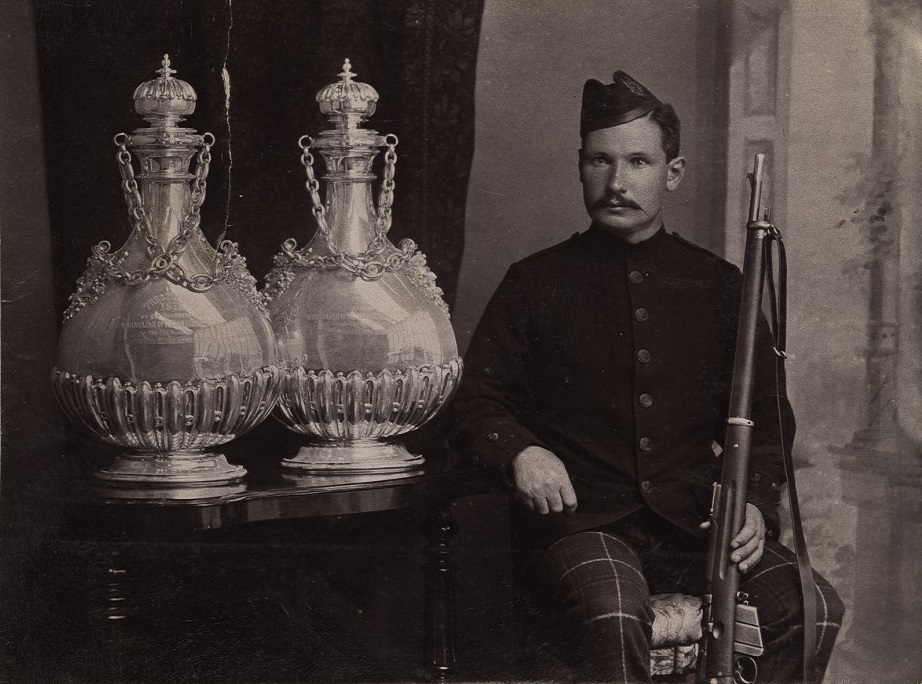
Private Brown, winner of the Imperial Prize at Bisley, 1894
The entry in the regimental Digest of Service for 1894 records that:
“The Battalion gained a large number of Prizes at the Browndown Rifle Meeting. At Bisley, the Imperial Prize which was open to Officers, N.C. Officers & men of the Regular Army was won by Pte J. Brown of the Battalion, who secured himself £100 & a pair of very handsome Silver Challenge Vases which were placed in the Officers Mess.”
1894 was the first year the Imperial Prize was competed for at Bisley, the home of British competition shooting since 1890. The Imperial Prize was competed for over two days of shooting. On the first day, competitors were allowed seven shots at targets placed at 200, 500, and 600 yards distance. Once the points were tallied, the top 100 progressed to the second and final day of shooting, comprising of 15 shots at a distance of 800 yards.
Newspaper reports from the time record that the weather over the two days of shooting was far from ideal, with heavy rain and high winds. At the end of the 500 yards stage of the event, the two highest scorers were a Lieutenant of the Scots Guards, and a Sergeant of the Northamptonshire Regiment. A good round at the 600 yards target saw Private Brown of The Cameronians in contention for the win, in what turned out to be a very close final round:
“The contest virtually lay between Col.-Sergt Phillips, Sergt.-Major Brown, and the winner. The sergeant-major finished with 152, at which time Private Brown had 148, and two shots to go. His fourteenth was a bull. He took a long aim for his last, and as the signal from the target was some time in making its appearance it was thought he had missed. A cheer was raised when a bull was signalled.”
Edinburgh Evening News, 13th July 1894
Private Brown won the competition with a score of 158, five points clear of the runner up, Captain Cowie of the Royal Engineers. Described in one newspaper account as a ‘young’ soldier, Brown was almost 40 years old when he won the Imperial Prize, and had originally joined the 90th Perthshire Light Infantry, an antecedent regiment of The Cameronians (Scottish Rifles), in February 1874. The article from the Edinburgh Evening News closes with the remark “Up to this year the winner had not been an abstainer from ardent spirits, but he is, and has been all this year, a teetotaller.” This somewhat curious statement takes on new meaning when one examines Private Brown’s service record. Born in Londonderry, John Brown enlisted for service at Hamilton on 28th February 1874, aged 18 and 6 months. He had previously been occupied as a Labourer. Brown’s military service got off to something of a rocky start when, after only five months service, it was discovered that he had neglected to mention he was actually enrolled in the Londonderry Light Infantry militia at the time of his enlistment with the 90th. There follow a number of instances of imprisonment by order of the Commanding Officer, until September 1876 when Brown is transferred to the 73rd Regiment (another Perthshire regiment). Whether this transfer was at his own request, or by order of the Commanding Officer of the 90th, is not recorded. The transfer did, however, mean that Private Brown would miss active service with the 90th in South Africa (1878-1879).
While with the 73rd, Brown continues to appear before his Commanding Officer resulting in further spells in prison, and numerous instances of loss of Good Conduct Pay. Despite his frequent clashes with regimental authority, Brown is permitted to extend his period of service to 12 years ‘with the Colours’ in July 1879. This would suggest that, while numerous, the nature of these ‘crimes’ were not serious enough to warrant discharge and were probably related to drunkenness.
Brown re-joined the 90th Perthshire Light Infantry on 30th September 1880, remaining with it through it’s transition to become the 2nd Battalion Scottish Rifles following the amalgamation with the 26th Cameronian Regiment in 1881. The cycle of ‘Awaiting Trial’ followed by ‘Imprisoned’ along with the occasional ‘Forfeiture of Good Conduct Badge’ continue until early 1894. A spell of good behaviour sees his first Good Conduct Badge restored on 28th February 1894, followed by a second on 30th August of that year. If the newspaper article quoted earlier is to be believed, we might assume that this period of improved conduct is a result of Private Brown’s newly found sobriety. Whether this change in personal circumstance also led to Brown’s success at Bisley can only be guessed, but we can assume that he had already demonstrated some skill at musketry before winning the Imperial Prize. This photograph is from another album in the regimental collection and is captioned simply as “Shooting Trophies – Aldershot – 1891-1893”:
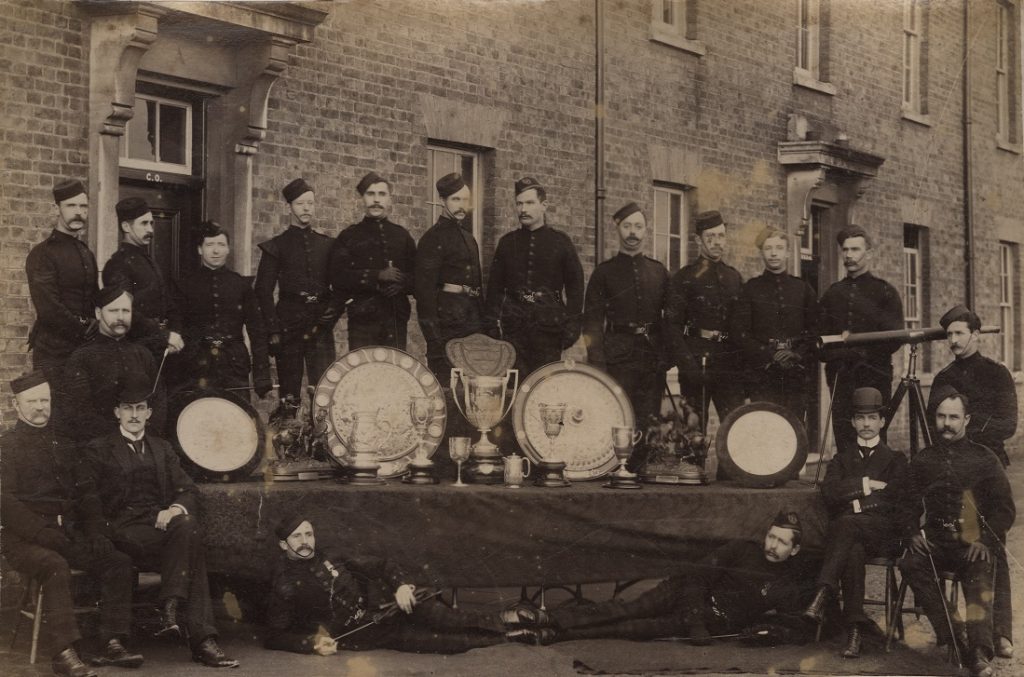
Private Brown is standing in the back row, fifth from the right. His appearance in this photograph might suggest he was already an accomplished marksman and may have indeed contributed to the securing of one or more of the prizes on display.
As the above photograph demonstrates, The Cameronians were not unused to success in competitions of shooting and musketry. In 1893, the 1st Battalion had taken 1st and 2nd Prize in the “Evelyn Wood Competition” at Bisley; a group event focused on a mix of marching and shooting. Still, winning a competition as grand as the Imperial Prize was something worth celebrating:
“Private Brown, of the Cameronians, who won the Imperial Cup at Bisley, returned to Portsmouth, where his regiment is quartered, on Saturday night, and met with a right royal reception… A telegram was received by the regiment during the evening from Sergeant-Major Brightman that the winner would arrive by the 9.43 train. Accordingly a waggonette, with the regimental band and pipers, was at the station to receive him. The news had got abroad, so that besides his comrades there was a large crowd ready to meet the successful marksman. The train was about an hour late and when it did draw up at the low level platform there was an enormous crowd awaiting it. On emerging from his compartment, Brown experienced an enthusiastic reception, and the crowd and his comrades carried him amid ringing cheers to the waggonette, while the band struck up “See the Conquering Hero Comes.” The cups were carried by Sergeant-Major Brightman and Sergeant-Instructor Jennings. On reaching the barracks Brown was escorted to the Officers’ Mess, where he was received by the officers, who complimented him heartily on his success.”
Hampshire Telegraph, 28th July 1894
Further evidence of the Battalion’s pride in securing the Imperial Prize is demonstrated by the above photograph being published as a postcard by the Battalion in 1894, with the addition of some recently acquired silverware!
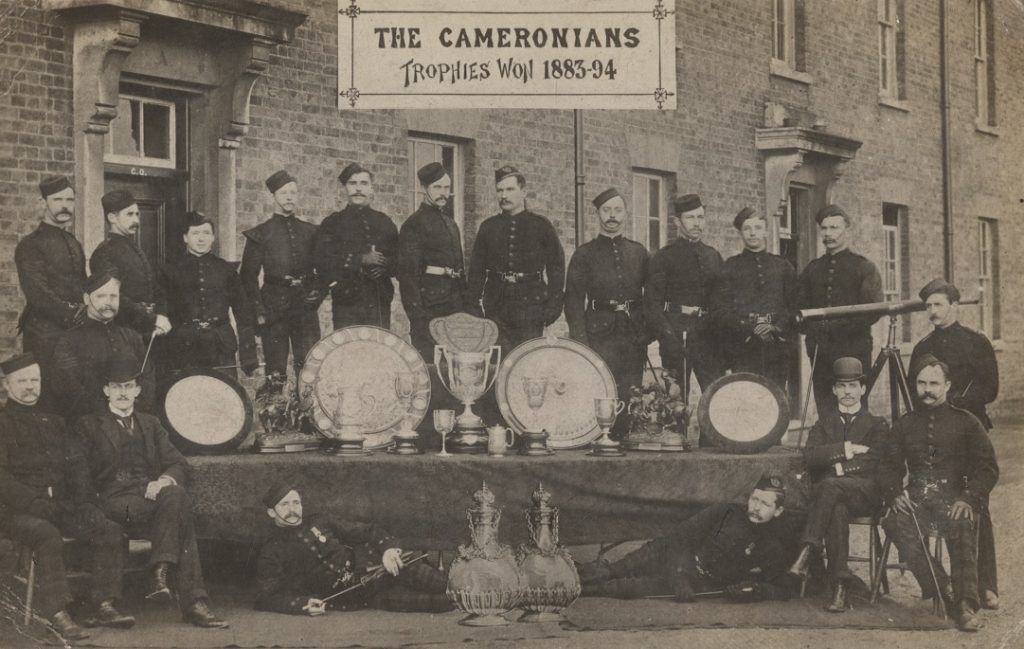
Postcard published by The Cameronians in 1894. The challenge vases won as part of the Imperial Prize have been super-imposed in front of the display of silverware won by the Battalion.
Following the restoration of his Good Conduct Badges in 1894, there are no further reprimands or reductions logged in Private Brown’s service records and he was finally discharged from the 1st Battalion The Cameronians (Scottish Rifles) on 30th March 1895, with 21 years and 34 days service under his belt. Of this, 19 years and 251 days would count towards his pension – bad behaviour comes with a cost after all!
Comments:
“For Services Rendered…” 31st July 1917
Today marks the anniversary of the opening of the Third Battle of Ypres, 31st July 1917, also known as the Battle of Passchendaele. This was the start of a British-led campaign that would continue into November of that year, and result in almost half a million casualties from both sides. Even at the time, the decision to launch the offensive met with controversy, and its objectives, successes and failures are subjects that will continue to be debated for many years to come. While the merits of this particular campaign, and indeed the events and circumstances surrounding the First World War itself, are continuingly being scrutinised, these anniversaries can provide an opportunity to look back and take a moment to remember the individuals who took part.
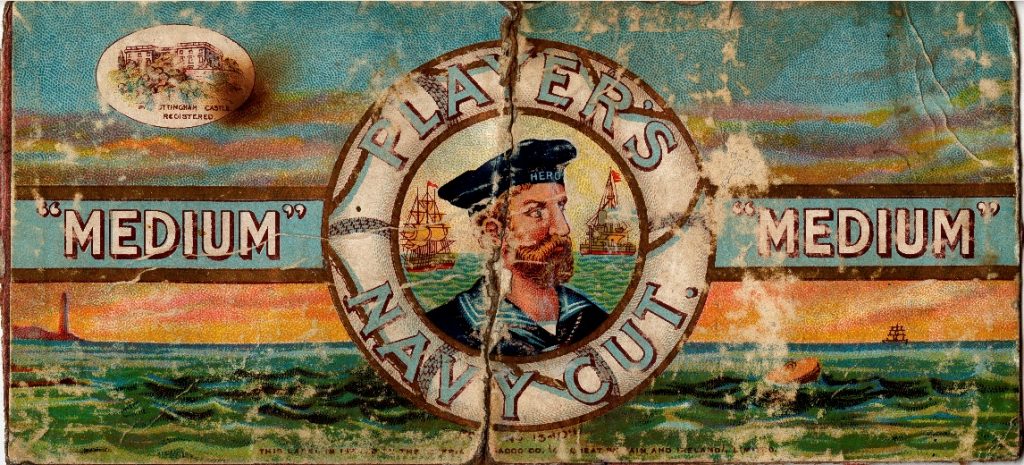
This fragment of a cigarette packet is probably one of the smaller, more fragile objects that make up The Cameronians (Scottish Rifles) regimental museum collection. It is the type of thing that, under normal circumstances, might have easily been discarded by its owner without much thought. So why should such an item have been kept, and ultimately deposited in a museum? A look at the scribbled message on the reverse of the packet reveals the significance of such an everyday item.
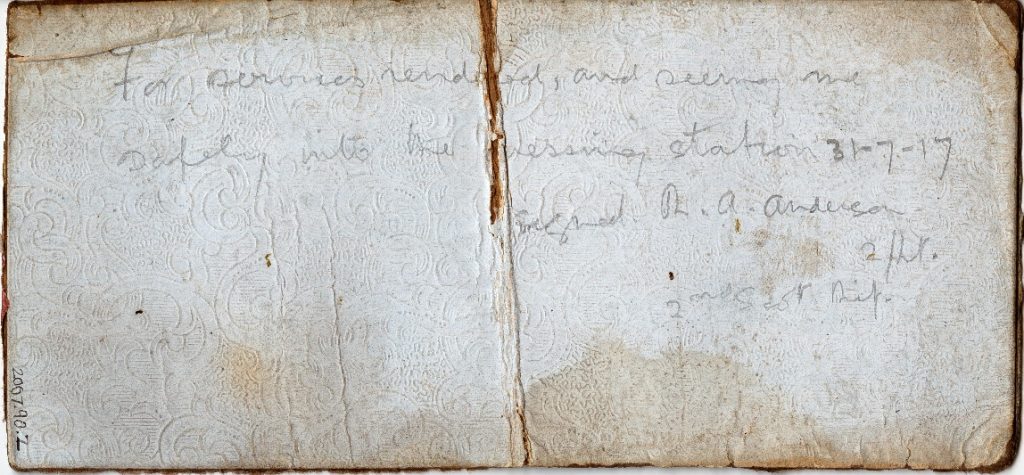
The message reads: “For services rendered, and seeing me safely into the dressing station 31-7-17, signed R. A. Anderson, 2/Lt, 2nd Scot. Rif.”
This was the dictated message from 2nd Lieutenant Roderick Andrew Anderson, of the 2nd Battalion The Cameronians (Scottish Rifles), to Private George Gould from Edinburgh. Lieutenant Anderson was just one of many of the 2nd Scottish Rifles who was wounded on 31st July 1917, and Private Gould was the man who helped the wounded officer to the Battalion dressing station, quite possibly saving his life. The men were of similar age, around 20 years old. Anderson’s wounds were serious enough that he was evacuated from the Front, and he would not return to the 2nd Battalion until 25th June 1918, almost a year later. Before leaving the Battalion area, Anderson asks for the above message to be written on his cigarette packet, and that it be passed to Private Gould as a small token of his thanks. Whether Private Gould was a smoker or not, we do not know. Perhaps he shared the cigarettes with his friends, or traded them for sweets or other useful items. What we do know is that he kept the packet with its message of thanks until the day he died. George Gould was killed on 6th January 1918, still serving with the 2nd Scottish Rifles. The cigarette packet was returned to his family with his personal effects; years later it, along with some photographs and his Memorial Death Plaque, was donated to the regimental museum collection.
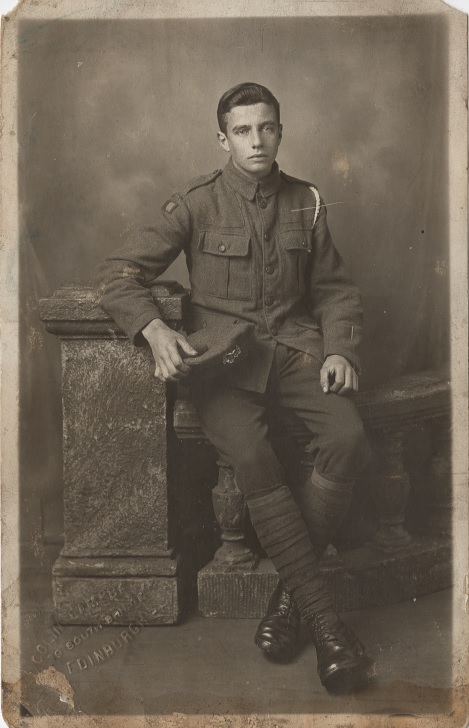
Private George Gould
This photograph of George was probably taken during a visit home. It was taken at Colin Campbell’s studio on 39 South Bridge, Edinburgh, not far from where George and his family lived, at number 63. The gold stripe worn on his lower left sleeve indicates he had been wounded on service. George had been recorded in a list of wounded soldiers sent to Stobhill Hospital on 8th May 1916, published in The Scotsman newspaper. At the time, George was serving with the 1st Battalion King’s Own Scottish Borderers – he subsequently transferred to the 2nd Scottish Rifles. The Wound Stripe alone is evidence that George had served at the Front by the time this photograph was taken. The patch worn on the right sleeve, below the shoulder seam, is that of the 8th Division, in which the 2nd Scottish Rifles served for most of the War’s duration. You can see an original example of this badge on our Online Collections browser – http://www.sllcmuseumscollections.co.uk/search.do?id=147158&db=object&page=1&view=detail
By the time Roderick Anderson returned to the 2nd Scottish Rifles, George had been killed and buried in Passchendaele New British Cemetery. Anderson would survive the First World War, finishing the War with the rank of Captain. In June 1919 he was awarded the Military Cross for his services in the First World War – the original citation for which reads:
“This officer has served with the Bttn since 1916 except when he was wounded. He took part in many engagements as a platoon commander and in the Battle of Ypres 31/7/1917 led his platoon with skill and determination. He takes a keen cheerful and intelligent interest in his work and has been at all times a conscientious hard working officer. Lately he has been performing the duties of Asst. Adjutant during whose absence he has done his work with considerable credit, both in action and out of the line. He is an exceptionally keen soldier.”
Roderick remained in The Cameronians (Scottish Rifles) after the First World War, serving with the 2nd Battalion in India and Kurdistan. He married in 1931, and had two children. In April 1935, Roderick resigned his commission from the British Army; he returned to his native New Zealand with his family to work in his father’s engineering business. Civilian employment didn’t quite agree with Roderick, and he joined the Royal New Zealand Air Force in 1937. During the Second World War, Roderick volunteered to serve once again with The Cameronians, and he duly joined the 1st Battalion in 1941, serving with them in Burma. He was wounded near Pegu in March 1942, by which point his age and the physically gruelling conditions of active service were taking it’s toll. He was posted to a Staff position and remained in service until the end of the Second World War, retiring with the rank of Lieutenant Colonel. Roderick’s health never quite recovered from his service in the Second World War, and he died in 1958 aged 60. Brigadier W. B. Thomas, an old comrade of Roderick’s since the two were at Sandhurst together in 1915, wrote of him:
“Roderick Anderson and I joined the Regiment from Sandhurst on the same day in April, 1916. We served together almost continuously until he retired and went to New Zealand in 1935. As he was employed with the New Zealand Air Force he need not have come back during the war, but such was his love for the Regiment that he was determined to serve with it. He rejoined the 1st Battalion in Secunderabad in 1941. Unfortunately there was not time for him to get as fit as the rest of us before he went to Burma. The arduous retreat inflicted a strain on his health from which he never fully recovered. Nethertheless he always pulled his weight and set an inspiring example. He was a wonderful friend and companion.”
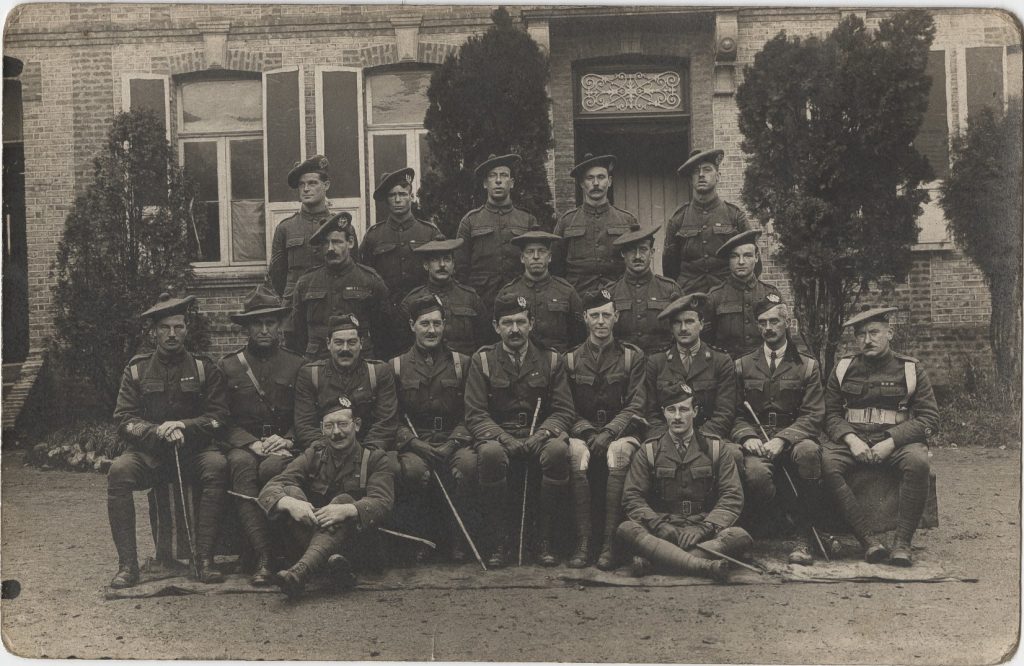
Roderick Andrew Anderson, seated cross-legged, right of front row. This photograph was taken shortly after the Armistice in November 1918, and shows Officers, Warrant Officers and Non Commissioned Officers of the 2nd Scottish Rifles.
The War Diary for the 2nd Scottish Rifles records that 38 officers and men of the Battalion were killed on 31st July 1917, and a further 146 wounded, while 19 men were reported missing in action. Roderick Anderson was among those wounded; perhaps his fate might have been different had it not been for George Gould.
Comments:
“The Four Youngest Cameronians” 1891
A recent enquiry concerning a photograph on display in Low Parks Museum prompted me to look into the photograph in more detail, and see what information, if any, we could learn about “The Four Youngest Cameronians”. The original photograph is contained within a regimental photograph album; a check of the album page showed that the surnames of the boys had been written in pen, underneath the photograph. Sadly, many of the photographs in the regimental collection fail to record the names of those shown, so it was fortunate in this case that the boys had been named, and the date on which the photograph was taken had also been recorded.
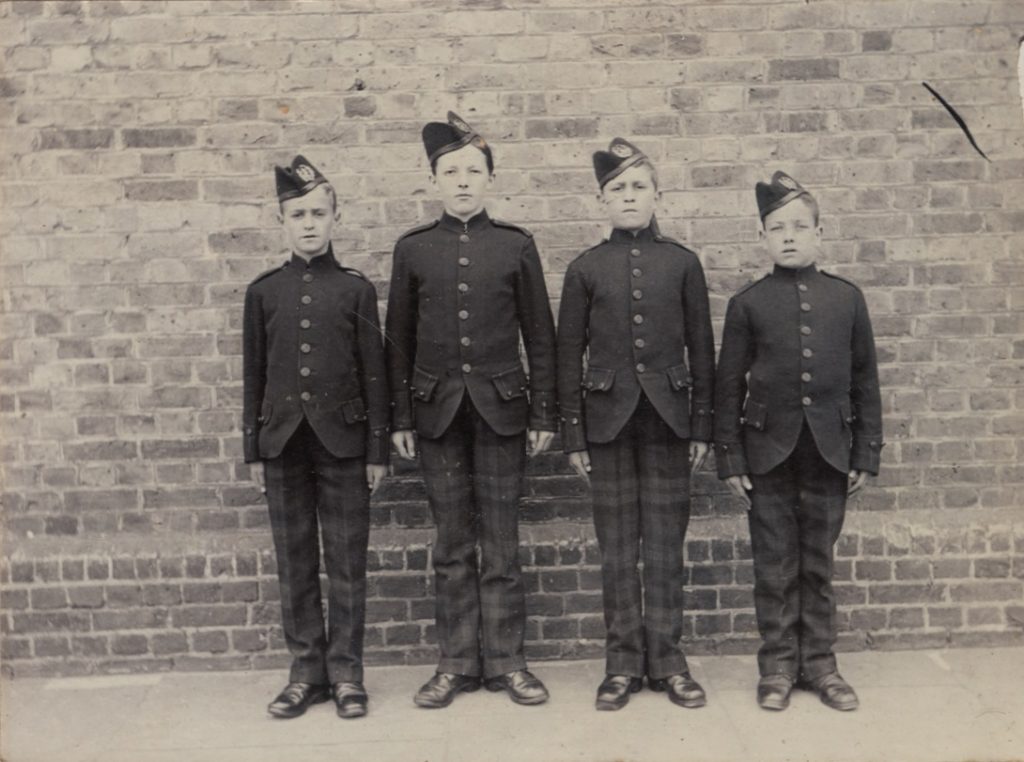
“The Four Youngest Cameronians” 1891
The image has been captioned as “The Four Youngest Cameronians” and the individuals are named, left to right, as Boys ‘Banks’, ‘Baldock’, ‘Banks’, and ‘Chamberlain’. The photograph was taken on 8th July 1891. ‘Boy’ was the rank used by the Army for young soldiers under the age of 18.
The photograph is interesting as the Boys are wearing Government Tartan trews as opposed to the Douglas Tartan that we generally associate with The Cameronians (Scottish Rifles). Permission was granted by Queen Victoria in May 1891 for the Regiment to adopt the use of Douglas Tartan, but this did not come into effect until 1st April 1892.
Looking at the names, the somewhat unusual name of Baldock jumped out as familiar, and doing a quick check of our other collections I found that he was named in another image in the museum collection. Amazingly, I also found a record in our Regimental Enlistment Registers (1919-1934) for a William J H Baldock, who had enlisted at Cork on 11th December 1890, aged 14. The entry would suggest that William Baldock had served in the Regiment continuously from December 1890 until his retirement as Regimental Sergeant Major in January 1922. He had served in the Boer War, and the First World War, and had been awarded the Queen’s and King’s South Africa Medals, the 1914-15 Star, British War Medal and Victory Medal, and also the Long Service and Good Conduct Medal.
There were no obvious matches for the other names in the Enlistment Registers, so I assumed that both Banks Boys and Boy Chamberlain had left the Regiment before the enlistment books commenced in 1919. Time to go to the local library to see what information I could find on Ancestry.com (if you don’t have a membership for Ancestry it is worth checking with your local library as many provide free access).
Working on the assumption that all the boys were around the same age as William Baldock, I was able to find service records for an Alfred Ernest Banks, an Edward William Banks, and a Charles Alfred Chamberlain. Alfred Banks joined the 1st Battalion at Cork on 9th January 1891, aged 14 years and two months. Edward Banks joined at Aldershot on 30th June 1891, aged 14 years. Charles Chamberlain also joined at Aldershot, on 1st July 1891, aged 14 years. The 1st Battalion The Cameronians had been stationed in Cork until 28th January 1891 when it embarked on HMS Assistance en route for Aldershot. Charles Chamberlain joined just in time to have his photograph taken 7 days later!
The Banks Boys appear to be brothers; both listed their mother as next of kin – Alice Banks of 1, The Crescent, Sandgate. Interestingly, Alfred was born in Richmond Barracks, Dublin, and his father is listed as ‘Joseph Banks – address unknown’, so it is possible that Alfred’s father was a soldier. Edward was born in Dover, and there are no details of his father recorded. Given the stated ages of Alfred and Edward and their places of birth, I think we must assume that one of them (or possibly both) provided false information as to their true age. The service records helpfully provide physical descriptions of each recruit – including height. Alfred (4′ 8″) was the taller of the two Banks Boys, so we might assume that he is shown second from the right in the photograph above, and that Edward (4′ 7″) is first from the left.
Charles Chamberlain served for four years with The Cameronians. He remained with the 1st Battalion for all of his service. On 27th June 1895 he was attested as a Private soldier, presumably on his 18th birthday. Charles found himself in a spot of bother in December 1895 which cost him the forfeiture of his Good Conduct pay. Whatever happened was serious enough to warrant a trial, and in January 1896 Charles was convicted and sentenced to 14 Days imprisonment with Hard Labour for “absence from Defaulter’s parade”. Charles was discharged on 18th January 1896 “in consequence of his services being no longer required”.
The Banks boys both went on to serve in India with the 2nd Scottish Rifles. Edward also saw service in South Africa in the Boer War and was awarded the Queen’s and King’s South Africa Medals. Alfred left the Regiment on 2nd January 1903, after 12 years service. Edward left on 7th June 1904, just short of completing 13 years service.
Ironically, we have less information available to us concerning William Baldock’s 30 plus years of military service than we do for the other three Boys in the photograph. This is because records relating to soldiers still serving after 1921 are currently not publicly available; William’s military records are still be held by the Ministry of Defence.
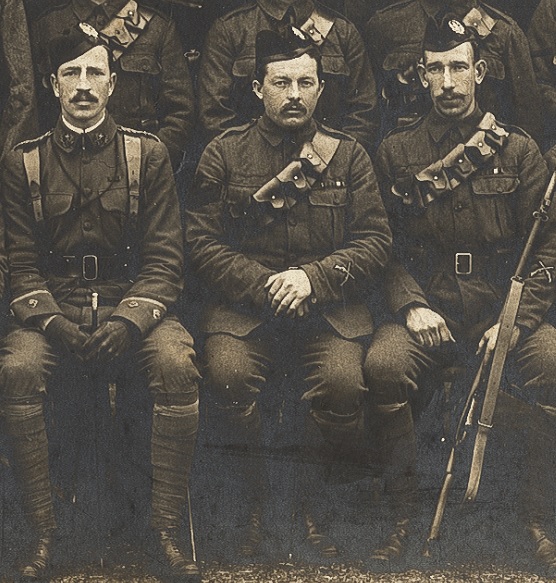
Colour Serjeant William Baldock, centre, 1908
We do know from William’s entry in the Enlistment Register that he served in South Africa from 1900 – 1904. William features in a group photograph of the 2nd Battalion in 1908, so it is possible that he remained with the 2nd after serving with them in South Africa. In this photograph William wears the rank of Colour Serjeant, a senior non-commissioned rank. The medal ribbons for his Boer War campaign medals can be seen worn above his left-chest pocket.
Since starting this research I have identified William Baldock in a photograph of the Serjeants of the 6th Scottish Rifles, which must date from between 1908 and 1914. The 6th Scottish Rifles was a Territorial Force battalion of The Cameronians, with headquarters in Hamilton.
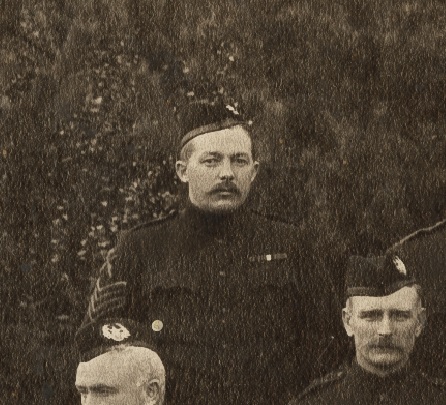
Colour Serjeant Instructor of Musketry Baldock
It was common procedure for senior figures from the Regular battalions of a regiment (the 1st and 2nd Battalions of The Cameronians) to serve on secondment to the Regiment’s Militia and Territorial Force battalions to assist in training and maintaining high standards of discipline. From the rank insignia displayed on William’s right sleeve, he is serving as the 6th Battalion’s Colour Serjeant Instructor of Musketry at the time this photograph was taken. William’s medal ribbons are also clearly visible in this photograph, consisting of the Queen’s and King’s South Africa Medals, and the Long Service and Good Conduct Medal.
William must have been still serving with the 6th Scottish Rifles when the First World War broke out in August 1914, and it was with this Battalion that he served with overseas in France. By the time of the Battle of Festubert in June 1915, William is the Regimental Serjeant Major of the 6th Scottish Rifles, the highest rank attainable by an enlisted soldier in an infantry battalion. William’s entry in the Enlistment Register records that he was discharged on 31st January 1922, with ‘Exemplary’ character. His address on discharge was given as 261 West Princes Street, Glasgow, then headquarters of the 5th/8th Territorial Battalion of The Cameronians (Scottish Rifles), which had only recently come into being following the amalgamation of the 5th and 8th Battalions. The regimental magazine for The Cameronians, called The Covenanter, records the occasion of RSM Baldock’s retirement in the March 1922 issue:
5/8th Battalion The Cameronians
The Warrant Officers and Sergeants of the Battalion had a very successful evening on Saturday, 28th January, which took the form of a Supper followed by a Smoking Concert. Major J. Murray Grierson represented the Commanding Officer who was unavoidably absent, and other officers were present. After the supper the chairman (C.S.M. Markwell) presented Sgt.-Major Baldock with a gold watch from the W.Os. and Sergeants as a token of their esteem and regard on his retiral from the regiment. C.S.M. Markwell in his speech before presenting the watch referred to R.S.M. Baldock as the perfect type of Sergeant Major – one who knew both office and parade sides of his work; one whose policy was that of the iron hand in the velvet glove, one who was ever courteous and helpful, yet “regimental” withal. These sentiments were loudly applauded. The watch, a fine enclosed hunter with the regimental crest on the front and in inscription inside the back cover, was then presented. In his reply, R.S.M. Baldock said he was particularly sorry to leave the battalion at the present time when two battalions were being amalgamated, but unfortunately it must be and all he could do was to wish all success to the new battalion…
It’s amazing to think that a simple photograph of four young soldiers, kept for posterity in a regimental photograph album, can provide such a fascinating glimpse into the lives of those shown, and the history of the Regiment in which they served.
Comments:
Merry Christmas and a Happy New Year
As we prepare to say farewell to 2016, we would like to take this opportunity to wish all our visitors a very Merry Christmas and a Happy New Year. We would like to also say thank you for visiting Low Parks Museum, our website, and reading our blog posts on The Cameronians (Scottish Rifles) museum collection.
We will leave you with this Christmas card from The Cameronians museum collection. It was sent from Pat to his ‘chum, Len’, most likely for Christmas 1927.
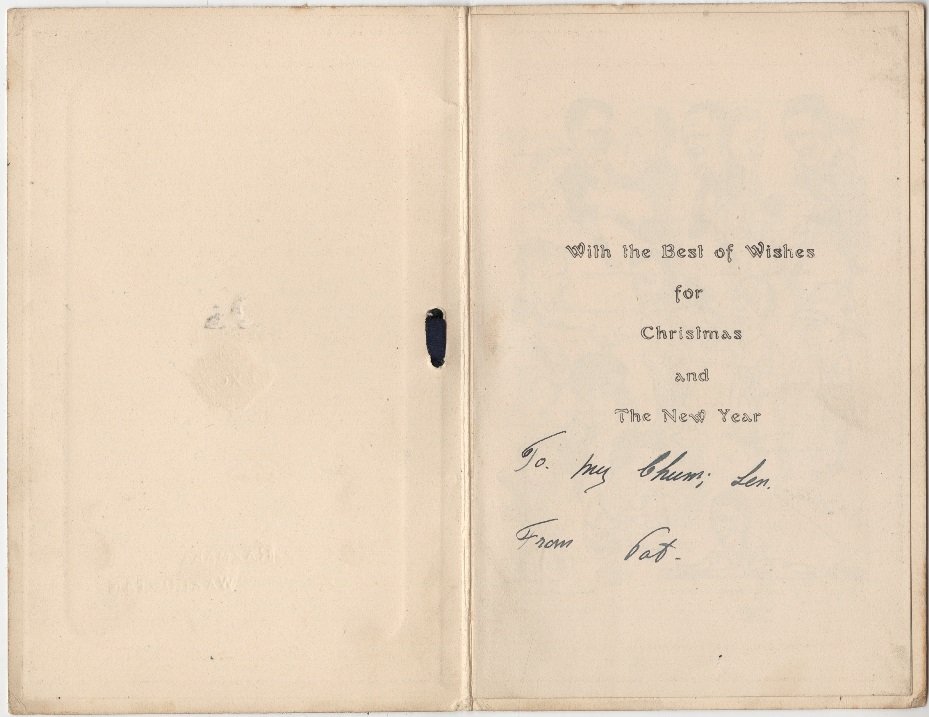
Unfortunately we don’t know anything about Pat or Len, but hope the caricatures contained in the card will be of some interest. They were sketched by J. E. B. Whitehead, an officer of The Cameronians who went on to have close involvement in the running of the Regimental museum.
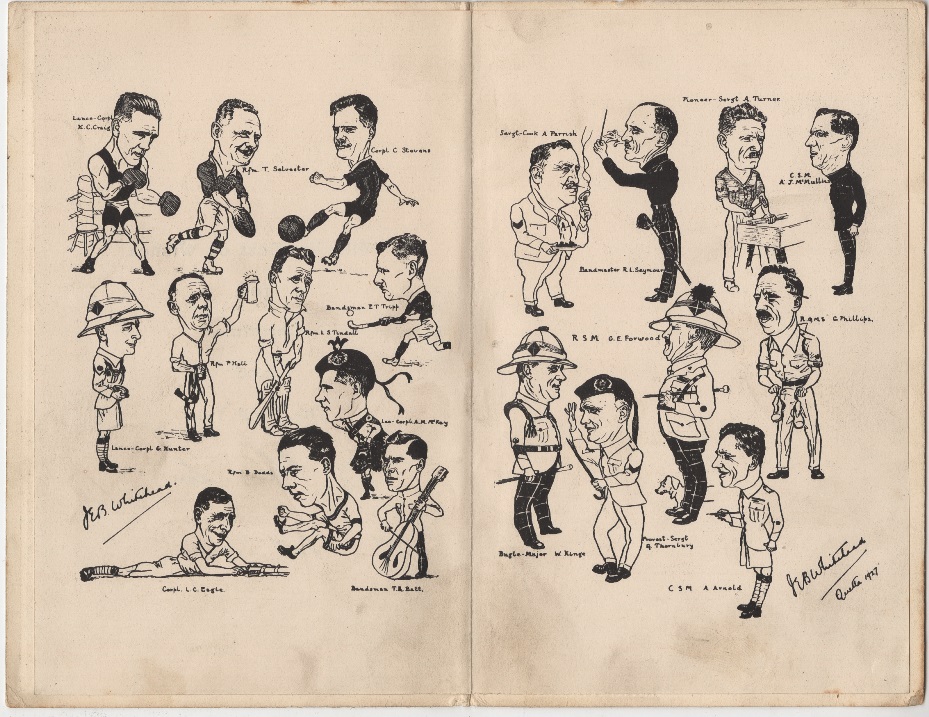
The sketches show a selection of ‘characters’ from the 2nd Battalion serving at that time (1927), including some of the Warrant Officers and Senior Non Commissioned Officers. Perhaps someone out there might recognise a relative!
We’ll see you all in 2017!
Comments:
Posted: 23/12/2016 by BarrieDuncan in Collections, Events
Why we remember
Tomorrow is Friday 11th November – the 98th anniversary of the signing of the Armistice concluding the hostilities of the First World War. At 11am tomorrow morning, people all over the country will stop what they are doing to observe the anniversary in a moment of silent reflection. On Sunday 13th, Remembrance Sunday, services will be held nationwide to commemorate those who died in conflict, past and present.
Many of the Remembrance events that will take place over the weekend will be centred around the First World War, and in particular the Battle of the Somme which ran from 1st July to 18th November 1916. Of course, the fighting in 1916 was not confined exclusively to the Somme region, nor indeed to the Western Front. This letter from the museum collection reminds us that the First World War was indeed a global conflict, and reminds us of the loss and sacrifice that comes with War.
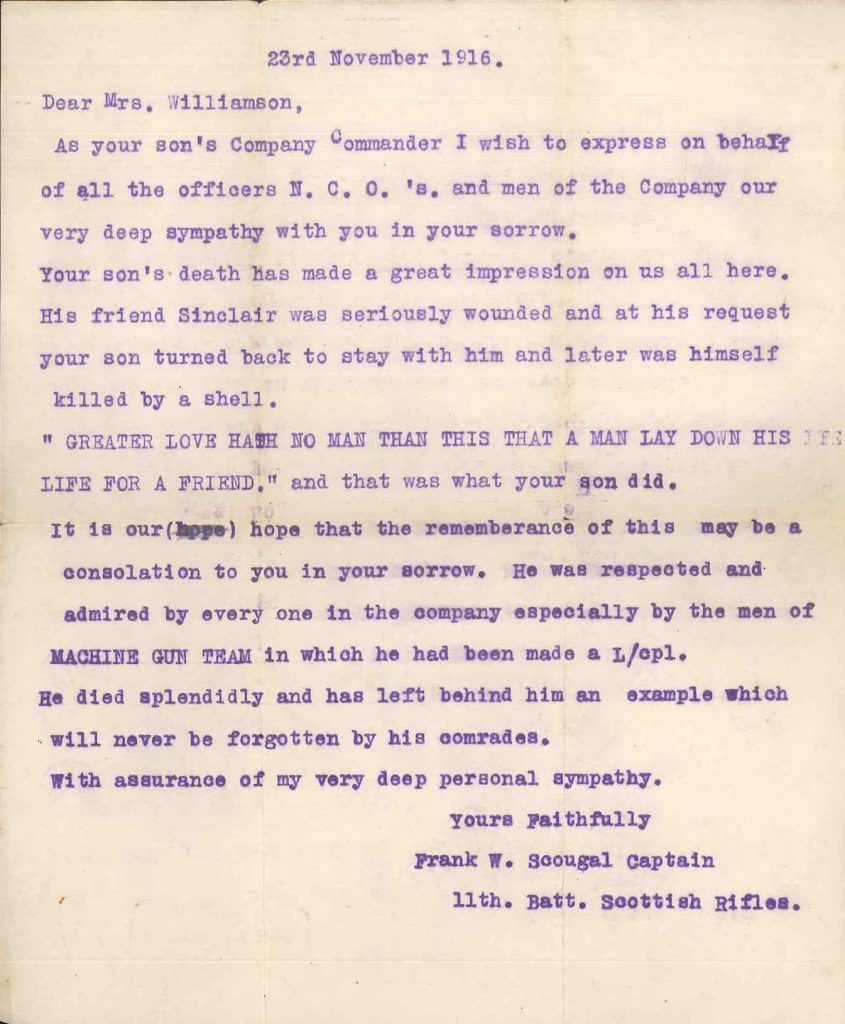
The letter was written to the mother of William Williamson, who was killed on 19th November 1916, by the officer commanding William’s company, Captain Frank Scougal. William was part of the 11th Scottish Rifles – a battalion of Kitchener’s Army serving at that time in Salonika, now part of Greece. In the letter, Captain Scougal explains that William died while trying to assist a friend, Sinclair, who had been badly wounded. Both men were killed by shellfire and were buried in Karasouli Military Cemetery.
Sadly, Frank Scougal did not survive the War; he was killed on 19th September 1918, just weeks before the signing of the Armistice. Tragically, Frank’s younger brother, Alec, had been killed the day before while serving on the Western Front. It is testament to the scale of the loss witnessed in the First World War that one short letter can come to represent the grief suffered by so many families.
Comments:
Log in