For Bravery in the Field – a follow up
Yesterday I wrote about the men of the 10th Scottish Rifles who went on a patrol into no man’s land on 21st December 1917. Sergeant John Wilson, from Hamilton, was one of the two men who returned to the British lines three days later, on Christmas Eve.
This morning I found some additional information that sheds some light on what happened to the brave Sergeant in the years following the First World War.
While searching through online newspaper articles, I came across an account in The Scotsman of King George and Queen Elizabeth’s Royal visit to Lanarkshire on 4th May 1938. The article recounted that, following a reception at Hamilton Town House, Their Majesties were making their way to their car when they observed in the crowd, a group of 14 men wearing medals. The King enquired who the men were, and was introduced to them by the Provost. The men were all limbless ex-servicemen from the area, and among them was none other than Sergeant John Wilson MM:
Mr Dodd [the leader of the group of ex-servicemen] drew His Majesty’s attention to John Wilson, holder of the Military Medal, who lost both his legs while serving in France. “How do you manage to get along?” inquired His Majesty, and Mr Wilson modestly replied. “Oh, fine.”
I then started looking through the regimental magazine of The Cameronians (Scottish Rifles), titled The Covenanter, and found an obituary notice for John Wilson, published in the January 1945 edition. It reads:
Death of Old Cameronian
We Regret to Record the death of Mr John Wilson, a linotype operator on the staff of “The Hamilton Advertiser” for over 35 years. Mr Wilson served as a non-commissioned officer in the Great War with the 6th Battalion The Cameronians (Scottish Rifles). He was twice wounded, once at Festubert and again in 1918 in an action in which he was awarded the Military Medal. He lost one of his fingers at Festubert. In 1918, he received a severe gunshot wound and suffered severely from frost-bite through forced to remain in “no-man’s-land” for three days. He had both legs amputated below the knee as a result of this experience. Following his discharge from the Forces, he returned to his civilian occupation and, because of his disability, was trained as a linotype operator. Even with two artificial legs he was very agile and served the firm faithfully and well up till the time of his death. There is no doubt that his general health suffered as a result of his war service, but “Jock”, as he was familiarly called, bore his illness with true Cameronian fortitude and was never heard to utter one word of complaint. Mr Wilson was one of the pioneers in the formation of Hamilton and District Branch of the British Limbless Ex-Servicemen’s Association, and was also an enthusiastic member of the Regimental Association of The Cameronians (Scottish Rifles). “Jock” also took a keen interest in “The Covenanter”, and in his capacity as a linotype operator he was given the job of setting-up the type for the magazine. This afforded him a great deal of pleasure and kept him very much in touch with the activities of his old Regiment. At the funeral to Bent Cemetery, Hamilton, his old Battalion was represented by the presence of its honorary colonel, Lieut. Col. J. C. E. Hay, C.B.E., M.C., T.D., D.L.
Further notifications in The Covenanter reveal that John Wilson bequeathed his medals to The Cameronians (Scottish Rifles) regimental museum, and also bequeathed a sum of money to the Regimental Museum Fund.
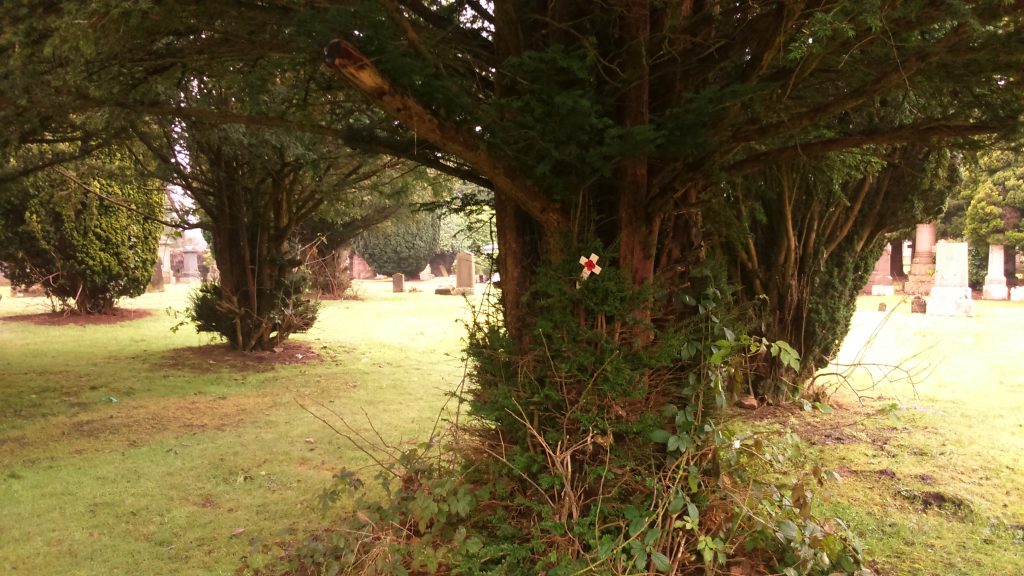
South Lanarkshire Council’s Bereavement Services were very helpful when I made enquiries about the whereabouts of Sergeant Wilson’s grave, and armed with plot details and a map I made my way there to pay my respects. It would appear, however, that Sergeant Wilson’s grave lies unmarked; perhaps not surprising as his obituary notice made no mention of any surviving family who might have arranged a headstone. I placed a memorial cross in a tree as near as I could estimate where Sergeant Wilson’s grave might lie.
On Christmas Day, safe and warm and in the company of my family, I’ll raise a glass and spare a thought for Lieutenant Ewen, Lance Corporal Thomson, Private Aberdeen, and of course, Sergeant John Wilson, and what they went through in no man’s land 100 years ago.
Comments:
For Bravery in the Field – 21st to 24th December 1917
100 years ago today, on 21st December 1917, a four-man patrol from the 10th Scottish Rifles left the relative safety of their trenches and crept in to no man’s land. Their objective was to establish the condition of the enemy’s defenses, and to try and establish the identity of the German unit defending them. It wasn’t until three days later, on Christmas Eve 1917, that two of the patrol would drag themselves back into the British lines – wounded, dehydrated, and suffering from exposure and frost-bite – while the other two members were presumed dead.
The two men who made it back to the British trenches on 24th December 1917 were Sergeant John Wilson, and Lance Corporal John Thomson. Both men were awarded the Military Medal for their actions on the patrol, but within a few days Lance Corporal Thomson had succumbed to his wounds, and Sergeant Wilson would ultimately have both his legs amputated as a result of wounds exacerbated by frost-bite.
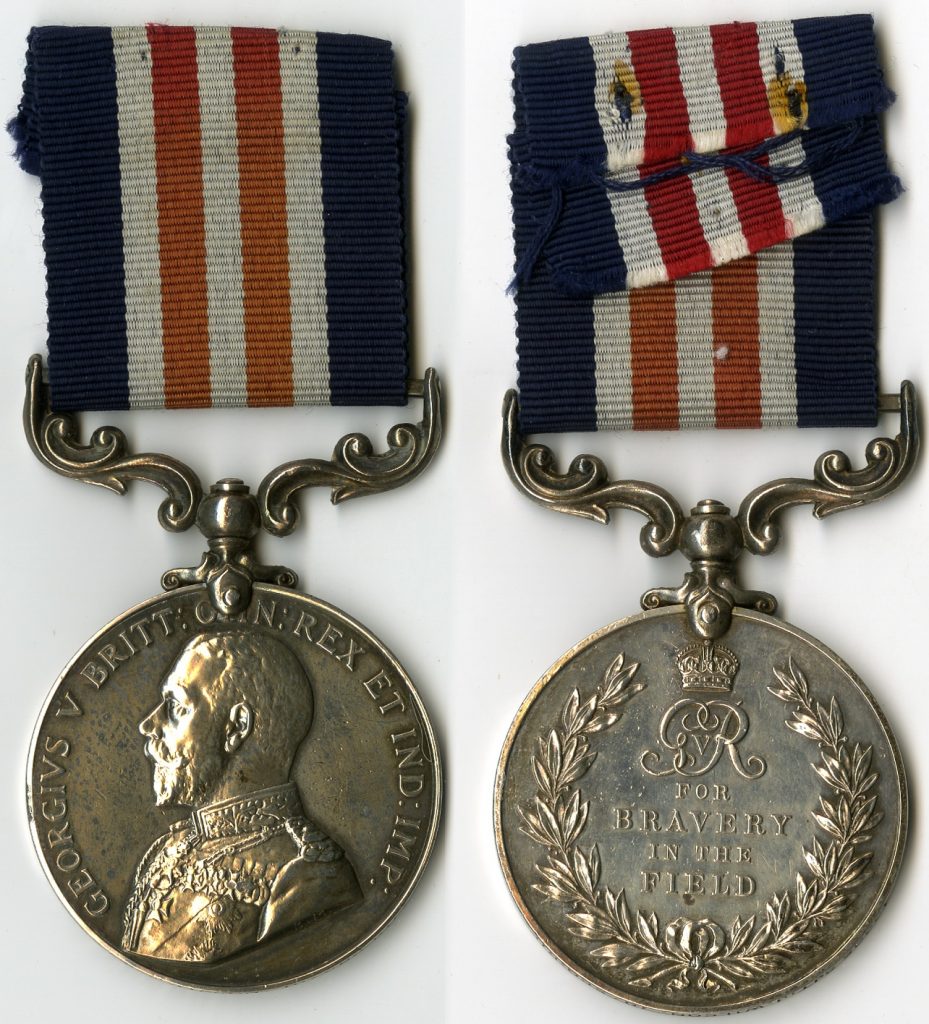
Military Medal of Sergeant John Wilson, on display in Low Parks Museum (obverse – left, reverse – right)
The patrol that set-out on 21st December 1917 comprised of four men; Second Lieutenant Ewen, Sergeant Wilson, Lance Corporal Thomson, and Private Aberdeen. Sergeant Wilson had led a similar patrol on the previous evening when a German post was encountered, but this was too well defended for them to try and rush in an effort to secure prisoners.
The patrol came up to what they thought was the German lines, but which actually turned out to be a small section of abandoned trench that the German forces were using as an observation and listening post. The lone German sentry was successfully captured by the patrol and while returning to their own lines they encountered and were attacked by a German patrol comprising of between 12 and 15 men. In the ensuing fight, the German prisoner was killed, and all four men of the British patrol became casualties. Lieutenant Ewen was thought to have been killed outright, and Private Aberdeen was badly wounded. Wilson and Thomson, both wounded, were able to get away, using the myriad of shell-holes as cover. Looking back, they saw the forms of Lieutenant Ewen and Private Aberdeen being dragged away towards the German lines.
Using the cover of darkness, Wilson and Thomson dragged themselves to what they thought was the British lines, only to find they had lost their way in the confusion of no man’s land and were actually near the parapet of the German trenches. It took them almost three days to make their way back to the British lines, as by this time Thomson was almost incapacitated through blood loss and the effects of exposure and Wilson had to physically drag him, even although he himself was wounded and suffering from frost-bite. Having survived all this, the unfortunate pair were almost met with the cruel fate of being killed by their own men, as when they first reached the British lines they were fired upon by the wary soldiers manning the trenches. On Christmas Eve they met a British patrol who assisted them back to the 10th Battalion’s lines.
The fate of Lieutenant Ewen and Private Aberdeen would not be known by the Battalion for some time. Wilson and Thomson had assumed Lieutenant Ewen killed in the fighting against the German patrol. He had in fact been wounded and taken prisoner. He recovered from his wounds, although he spent the remainder of the War as a prisoner in Germany. Ewen was a chemist and druggist in Aberdeen in civilian life; he had originally served as a private soldier in the Royal Army Medical Corps before being granted his commission and had only been serving with the 10th Scottish Rifles for a short time before commanding the fateful patrol.
Private Archibald Aberdeen was also wounded and taken prisoner. He succumbed to his wounds and died the next day, on 22nd December 1917. Private Aberdeen was buried by his German captors in a French cemetery behind their lines. In 1924, Private Aberdeen’s remains were reburied by the Imperial War Graves Commission in Cabaret Rouge British Cemetery among his comrades who died in the War.
Wilson and Thomson were awarded their Military Medals on 1st January 1918. Three days later, on 4th January, Lance Corporal John Barr Thomson died of his wounds and the hardships suffered during his ordeal in no man’s land. John Thomson was from Hamilton, Scotland, and was 38 years old at the time of his death. He is buried in Etaples Military Cemetery.
Sergeant John Wilson was also from Hamilton. He had joined the 6th Scottish Rifles, the local Territorial Force Battalion of The Cameronians (Scottish Rifles) in 1912. John was a compositor with his local newspaper, The Hamilton Advertiser. Embodied for active service when war was declared in August 1914, John first went to France with the 6th Scottish Rifles in March 1915. Like Lieutenant Ewen, Sergeant Wilson was only transferred to the 10th Scottish Rifles a few months before he took part in the patrol. He had already been wounded in action, and had also served for a short time with an Officer Cadet School where he was considered for training as an officer. During the December patrol described above, Wilson had suffered a gun shot wound to the left thigh. In addition he suffered severe frost-bite as result of spending so long in wet, freezing conditions. The damage to his legs was severe enough to result in him having both legs amputated, and he was discharged from the army on medical grounds in April 1918, aged 24.
Sergeant John Wilson’s Military Medal is on display in Low Parks Museum, in his native Hamilton.
Comments:
How Many Were Left?
After three years of bloody conflict, the First World War on the Western Front again settled into stalemate in the Winter of 1917-1918. As the new year dawned the British offensives at Arras, Ypres, and Cambrai were memories. All eyes now turned to the German offensive all ranks knew was coming. Given the costly fighting of the previous years one would not expect to see veterans of Loos or the Somme still manning front line trenches and preparing for the impending battle. Yet hidden in the war diary of the 9th Scottish Rifles for 4 February, 1918, lies a glimpse inside the makeup of the men who’d fight in the coming year of victory.
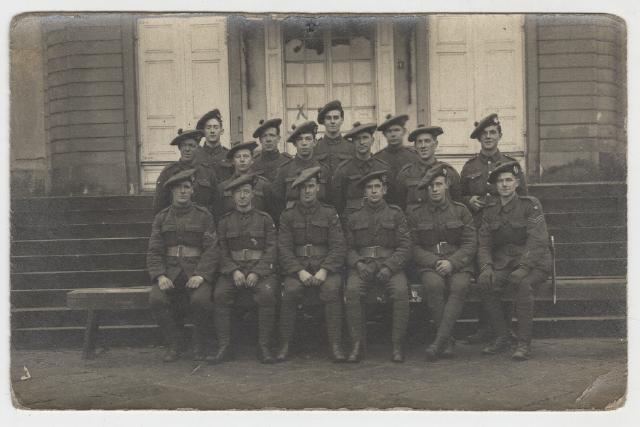
NCOs of C Coy, 9th The Cameronians S.R. Feb 1919, Germany – TNB or Thomas Nicholson Banks is identified in the 2nd row – belonged to Thomas Nicholson Banks who served with the 9th Bn The Cameronians S.R. The building in the background is Schloss Benrath, near Dusseldorf.
On that date the 9th Scottish Rifles were in rest billets in the French town of Vaux-Sur-Somme. They paraded in the morning in front of the Commanding Officers of their 9th (Scottish Division) and 27th (Lowland) Brigade. A group of the men were presented medal ribbons. In total the Cameronians of the 9th received:
Military Cross 2.
Bar to Military Medal. 1.
Military Medals. 14.
1914 ‘Star’. 49.
Belgian Croix de Guerre. 3.
49 men were left. 49 of those who had left Hamilton barracks in 1914 as part of Kitchener’s Army, one of the Glasgow or Lanarkshire territorial battalions, or of the two regular battalions who served in France in 1914-15. The 1914 Star was awarded in the Winter of 1917-1918 to those who had served overseas in 1914-15, and the amount awarded to members of the 9th Scottish Rifles gives s a glimpse of the experiences of the battalion, both through the few who remained, and the length of time those 49 had spent at the front with the Cameronians (Scottish Rifles) or their original units. There was still another year left to fight, and there would be thousands more men lost until the Armistice the following November. The 9th Cameronians (Scottish Rifles) would be at the forefront fighting during the Spring Offensive, at Mt. Kemmel south of Ypres as part of the Battle of the Lys, and the advance to victory.
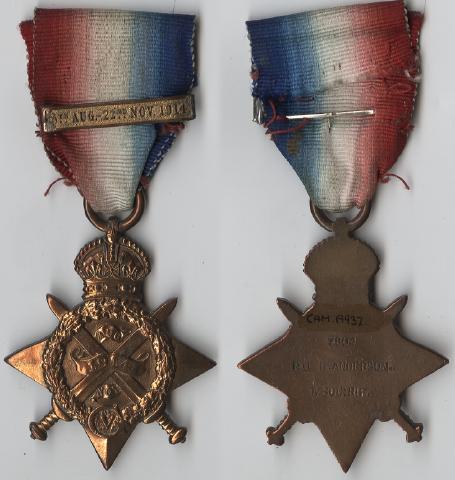
1914 Star Medal with bar: 5th Aug to 22nd Nov 1914. Awarded to 9804 Frederick Anderson 1/Scot Rif.
Comments:
Posted: 08/12/2017 by JamesTaub in First World War
Cameronians regimental collection named as of National Significance
The regimental collections of The Cameronians (Scottish Rifles) have been granted Recognition Status as part of a partnership bid through the Association of Scottish Military Museums. The award is made by Museums Galleries Scotland on behalf of the Scottish Government.
The combined Collection of the Scottish Regimental Museums has been Recognised as Nationally Significant to Scotland. These are the Royal Scots Dragoon Guards, The Royal Regiment of Scotland, The Royal Scots, The Kings Own Scottish Borderers, The Royal Highland Fusiliers, The Cameronians (Scottish Rifles), The Royal Highlanders (The Black Watch), The Highlanders (Queens Own Highlanders Collection), The Gordon Highlanders and The Argyll and Sutherland Highlanders.
Together they tell part of Scotland’s story, since before the Act of Union up until the present day. This is only the second distributed collection application to be successful – the first being the National Burns Collection.
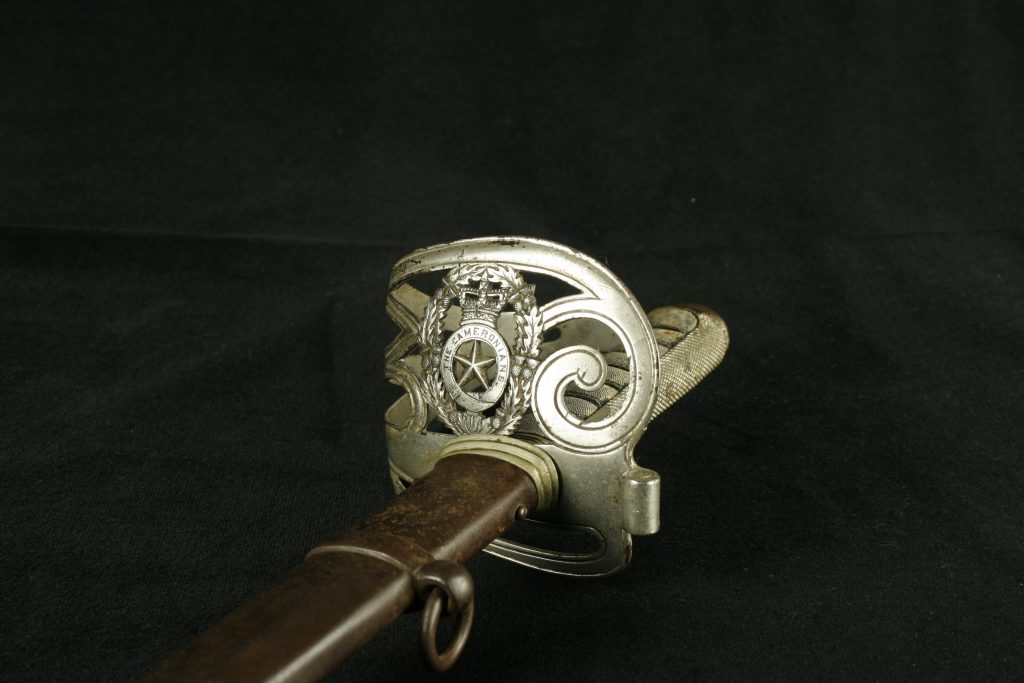
Regimental pattern officers sword, purchased by Sir Evelyn Wood VC for his son, Arthur
The Cameronians (Scottish Rifles) collections are owned by South Lanarkshire Council, and are under the care and management of South Lanarkshire Leisure and Culture. The collection is showcased in Low Parks Museum in Hamilton. It charts the regiment’s history spanning almost 300 years of service across the globe. It contains objects from its Covenanting origins, to the disbandment of the 1st Battalion in 1968, and beyond. The core regimental displays were refurbished in 2013 through a project funded by Museums Galleries Scotland and The Cameronians (Scottish Rifles) Regimental Trust. Low Parks Museum displays highlight the strong local connections The Cameronians shared with the towns and villages of South Lanarkshire. The regiment was originally formed as the Earl of Angus’ Regiment in Douglas, on 14th May 1689, and the 1st Battalion The Cameronians was disbanded there on 14th May 1968. Hamilton was home to the Regimental Depot from the creation of The Cameronians (Scottish Rifles) in 1881 until its move to Winston Barracks in Lanark in 1947. Hamilton has also been home of the Regimental Collection since the 1960s.
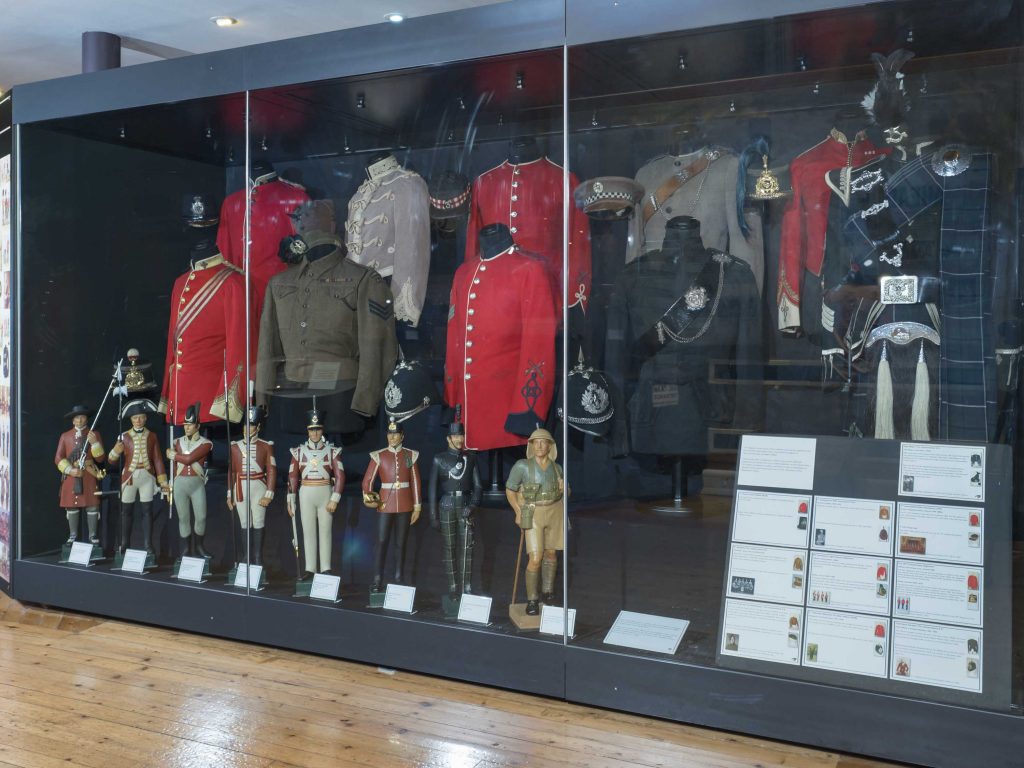
Display of regimental uniform in Low Parks Museum
Star objects on show include the sword of William Cleland, first Commanding Officer of the Earl of Angus’ Regiment; one of the first Colours carried in battle by antecedent regiment – the 90th Perthshire Volunteers; a unique collection of regimental uniform; and a medal collection charting the Regiment’s involvement in conflicts since the Napoleonic Wars of the early 1800s to Aden in the 1960s – including seven Victoria Cross medals awarded to men of the regiment.
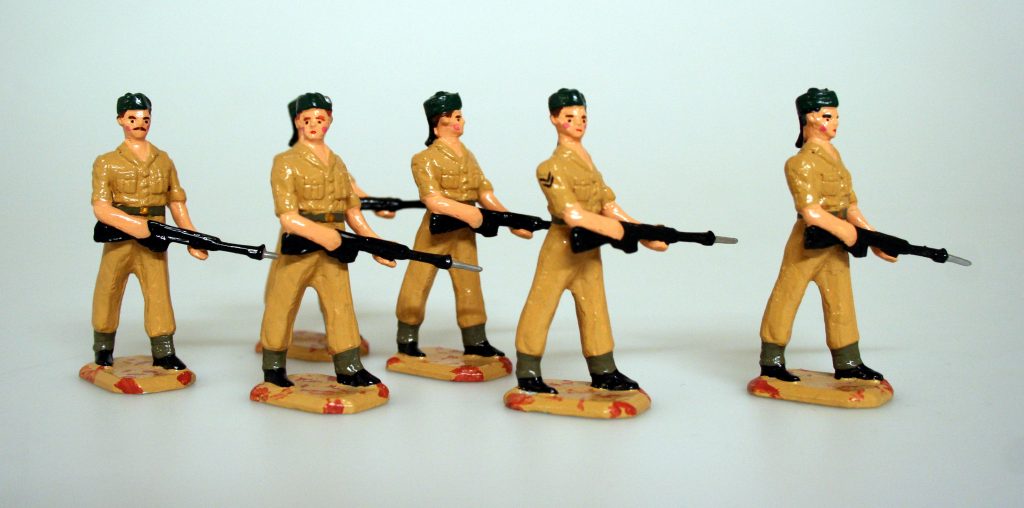
Model soldiers depicting a patrol in Aden, c.1966
Behind the scenes, continuing cataloguing and digitisation work helps improve our understanding of the objects in the collection, and their significance to local, Scottish and world history. A large selection of the regimental collections can be viewed online through South Lanarkshire Leisure and Culture’s website – http://www.slleisureandculture.co.uk/info/206/online
It is through the Association of Scottish Military Museums that the 10 museums work together. The Association also works closely with the Scottish National War Museum and the National Army Museum to ensure that Scotland’s military story is told to as wide an audience as possible. The Collection, comprising of over 160,000 objects, is distributed across Scotland; in Fort George, Aberdeen, Perth, Stirling Castle, Glasgow, Hamilton, and Edinburgh Castle, and also across the border in Berwick-upon-Tweed.
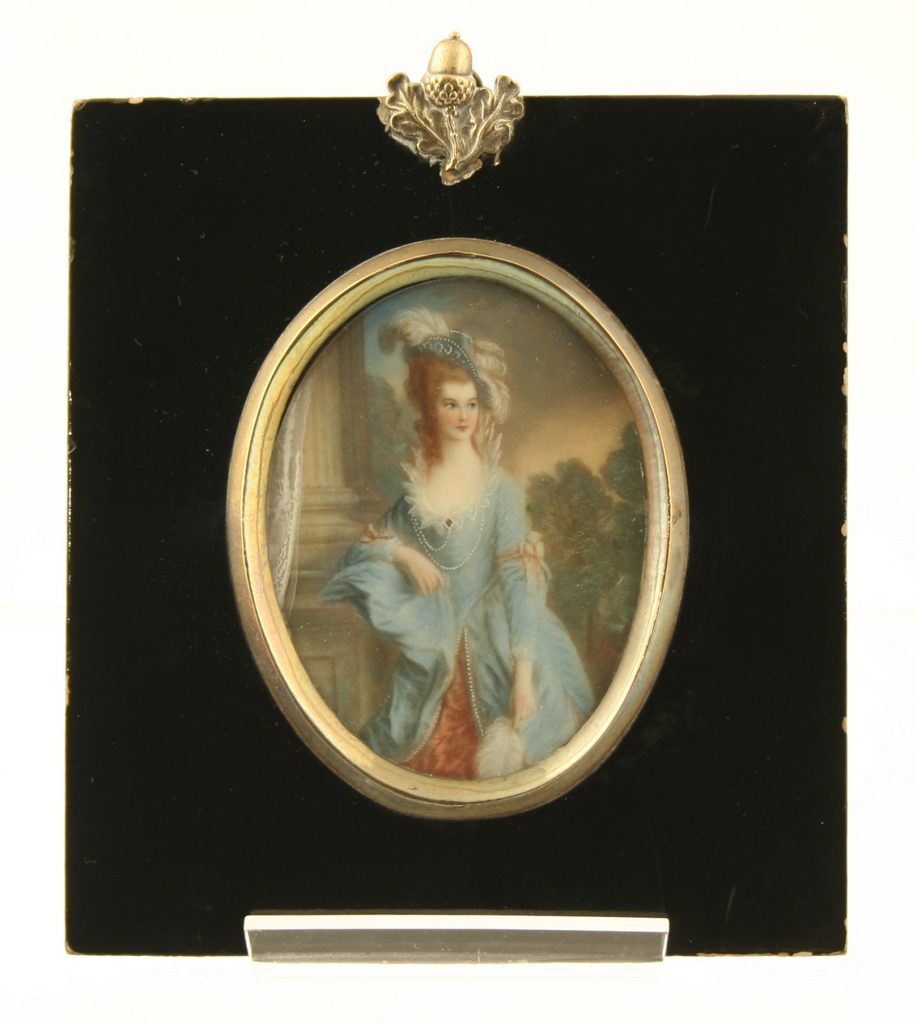
Miniature painting of the Honourable Mrs Graham, wife of Thomas Graham, founder of the 90th Perthshire Volunteers
The Recognition Scheme ensures that Scotland’s most important museum collections are identified, cared for and promoted to wider audiences. The award also opens up access for the partners of the Association of Scottish Military Museums to apply for Recognition funding from Museums Galleries Scotland to improve how people experience and engage with the Collection.
Comments:
Posted: 23/11/2017 by BarrieDuncan in Collections
A Cameronian View of Passchendaele
With the centenary of the Third Battle of Ypres drawing to a close, let us look back on the activities of the Cameronians (Scottish Rifles) in this infamous battle.
In actuality, the Third Battle of Ypres was divided into several smaller battles which took place throughout the Ypres Salient from 31 July to 10 November 1917. Battalions of the regiment were present at almost every single one of these smaller engagements. Starting on 31 July, the 10th Battalion with the 15th Scottish Division attacked German positions around Beck House on the Frezenberg Ridge. It’s four companies were divided up between various battalions of the Division as extra strength to assist in their various objectives. Simultaneously the 2nd Battalion with the 8th Division attacked along the banks of the Hanebeek.
Both the 2nd and 10th Scottish Rifles would return to the fight on 16 August, and both in relatively the same positions they had fought in in late July and early August. The 10th would assault positions such as Gallipoli Farm, Iberian Farm, and Beck House. The 2nd again attempted a crossing of the Henebeek and again suffered heavily casualties being bogged down in the mud.
On 20 September the 9th Scottish Rifles entered the battle with the 9th (Scottish) Division, assaulting the Frezenberg Redoubt. (Now the site of the Scottish Memorial.) This was the British Army’s first attempt to counter the new German defense in depth tactics which had stymied their advances earlier in August. The weather however, was beggining to interfere with any further pushes. As the 9th’s After Action Report records the effect on weapons:
Breech and Muzzle Covers were used by all except first waves, but still rifles were difficult to keep clean, and at Final Objective a great many were caked with mud, and, in a few instances, unserviceable. The need for cleaning rifles at earliest opportunity after objective is reached ought to be impressed on all ranks during training.
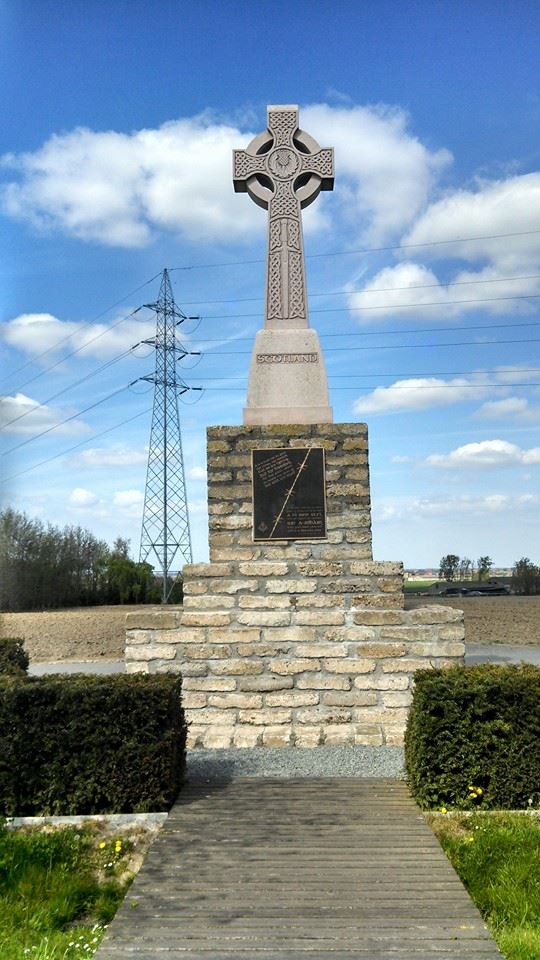
The Scottish Memorial, Frezenberg. Site of the 9th Scottish Rifles’ action in August, 1917.
By 26 September the 1st and 5/6th Battalions had arrived as part of the 33rd Division. They pushed up the Menin Road and through the South East corner of the now infamous Polygon Wood. Company Sergeant Major Docherty of the 5/6th Battalion noted the confusion of the fighting in a later issue of The Covenantor:
We went through and beyond the pill boxes and lay down; the shell craters in this area had to be seen to be believed. Serjeant Hay and I went along the line to get the men straightened out; dawn had broken by this time and men of the Suffolks and B and C Companies were all mixed up. The shelling was so bad on both sides and the confusion such that some of our men were digging in facing the direction from which our own artillery was firing.
The two battalions of the Cameronians with the rest of the 33rd Division successfully assisted the Australian attack which captured Polygon Wood. Though this was not without large losses to both sides.
Fighting continued into October with the 9th Battalion returning to attack a position near Kronprinz Farm. By 10 November the Canadians had captured Passchendaele Ridge, with the now destroyed village resting on top. They were relieved by units which included the 1st and 5/6th Cameronians (Scottish Rifles). The 5/6th took up position around a block house known as Tyne Cot. There the began to bury their own dead, as well as scattered dead from other regiments. Their War Diary reads
The beginning of a cemetery the Cameronians (Scottish Rifles) laid down grew into the famous
Tyne Cot Commonwealth War Graves Cemetery and Memorial to the Missing, the largest British and Commonwealth military cemetery in the world. Following the fighting the regiment settled down to endure the cold and trench warfare of the Winter of 1917-18. To come in the Spring was the great German offensives, and the war still had one full year to go.
Comments:
Posted: 29/10/2017 by JamesTaub in First World War
Log in