Two Pals Remembered
Earlier this year, Low Parks Museum in Hamilton was host to the First World War partnership exhibition, Next of Kin, coordinated by National Museums Scotland. As part of this exhibition, a commemorative scarf was made by two volunteers from Hillhouse Parish Church. The hand-knitted scarf is a reference to the wartime effort by volunteers at home who would knit hats, scarfs, gloves and socks for the comfort of soldiers at the front.
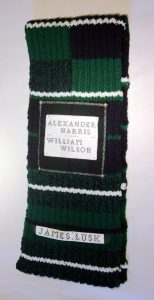
Commemorative Scarf, created by volunteers for the ‘Next of Kin’ exhibition
The volunteers, Marion and Margaret, decided to create this scarf in the regimental colours of The Cameronians (Scottish Rifles), green, blue, and black, and used a thick, ribbed pleating to echo the pleats of a piper’s kilt. They also added the name ‘James Lusk’ to the scarf; Captain James Lusk featured in our display as part of the Next of Kin exhibition. James was a native of Strathaven, South Lanarkshire, and a manager in the famous iron and steel company David Colville & Sons. Tragically, James died on 28th December 1915, of serious wounds he had received on Christmas Day while handing out cigarettes to the men in his battalion.
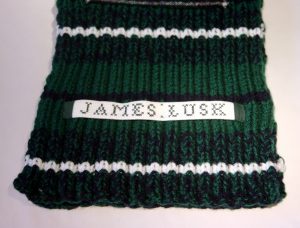
Captain James Lusk is commemorated on the scarf
While visiting The Cameronians displays in Low Parks Museum, Margaret had seen the objects on display that tell the story of Alexander Harris and William Wilson, who were the the subject of a previous blog post. Touched by the story of the two young pals, Margaret and Marion decided to add their names to the scarf.
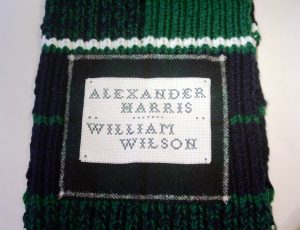
The names of Alexander Harris and William Wilson were added to the scarf, fixed to the same piece of Douglas tartan cloth
Margaret said that she had been struck by “how these young pals had enlisted together for Kitchener’s New Army, just like so many friends from every town, village and city throughout the country. The story of two ordinary boys who would become soldiers, signing up together with consecutive service numbers, just like so many others whose stories have been forgotten, and how they would have trained and fought together and for one of them to ultimately die and just how devastating this must have been to the other.”
You can see the scarf on display at Low Parks Museum, alongside a photograph of Alexander and William.
-

-
The scarf on display at Low Parks Museum
-

-
William (left) and Alexander
We would like to thank Margaret and Marion for all their hard work.
The Next of Kin exhibition is currently on tour, for venue details and dates please see the National Museums Scotland website for details – http://nms.ac.uk/national-international/sharing-collections/touring-and-lending/next-of-kin/touring-exhibition/
Comments:
A Letter from America…
As we approach the anniversary of the disbandment of the 1st Battalion The Cameronians (Scottish Rifles), this letter from the museum collection might be of interest, especially to those Cameronians and their families and friends who attended the disbandment parade on 14th May 1968.
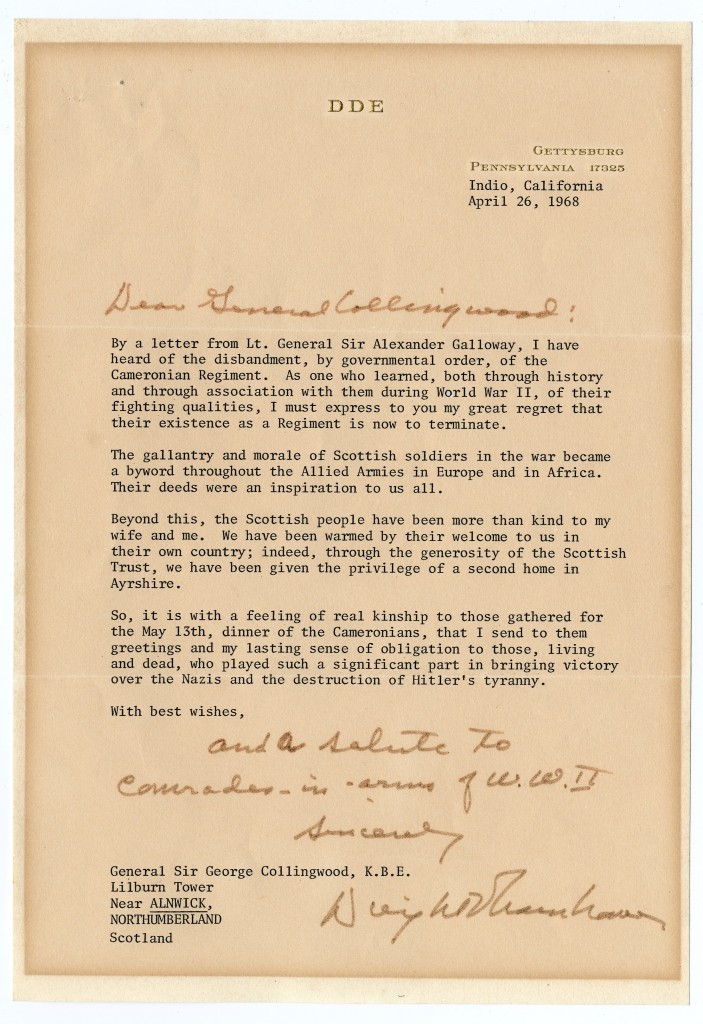
Letter from General Eisenhower in reference to disbandment of the 1st Battalion The Cameronians (Scottish Rifles).
It was sent to General Sir George Collingwood, then Colonel of the Regiment, on 26th April 1968, from General and former President of the United States of America, Dwight D. Eisenhower. During the Second World War, General Eisenhower had been Commander of the Supreme Headquarters Allied Expeditionary Force (SHAEF) from 1943-1945. The letter was written in reference to the upcoming disbandment of the 1st Battalion The Cameronians (Scottish Rifles). In the letter, General Eisenhower sends his greetings to all those attending the Regimental Dinner on the eve of the disbandment service. This dinner was attended by 188 officers, guests and friends of the Regiment, and included among the Regimental Guests, General Count Thord Bonde of Sweden. General Bonde was Aide-de-camp General to King Gustaf VI Adolf of Sweden (the Colonel in Chief of The Cameronians), and was in Scotland to represent His Majesty at the disbandment parade.
General Eisenhower signs off his letter ‘With best wishes, and a salute to Comrades-in-arms of W.W.II, Sincerely, Dwight Eisenhower’.
May we take this opportunity to send warm greetings to all Cameronians, their families, and friends of the Regiment, many of whom will have their own personal memories of the disbandment of the 1st Battalion.
Comments:
Posted: 29/04/2016 by BarrieDuncan in Days out, Events
Remembering Neuve Chapelle
Today marks the anniversary of the start of the Battle of Neuve Chapelle, in which the 2nd Scottish Rifles suffered heavy casualties taking and holding their objectives. This is a copy of a speech by the then Commander in Chief of the British Expeditionary Force, Sir John French, to the 2nd Battalion at an inspection on 12th April 1915. A copy of the speech was recorded in the 2nd Battalion’s War Diary, and also in the Digest of Service kept by the Regimental Depot in Hamilton.
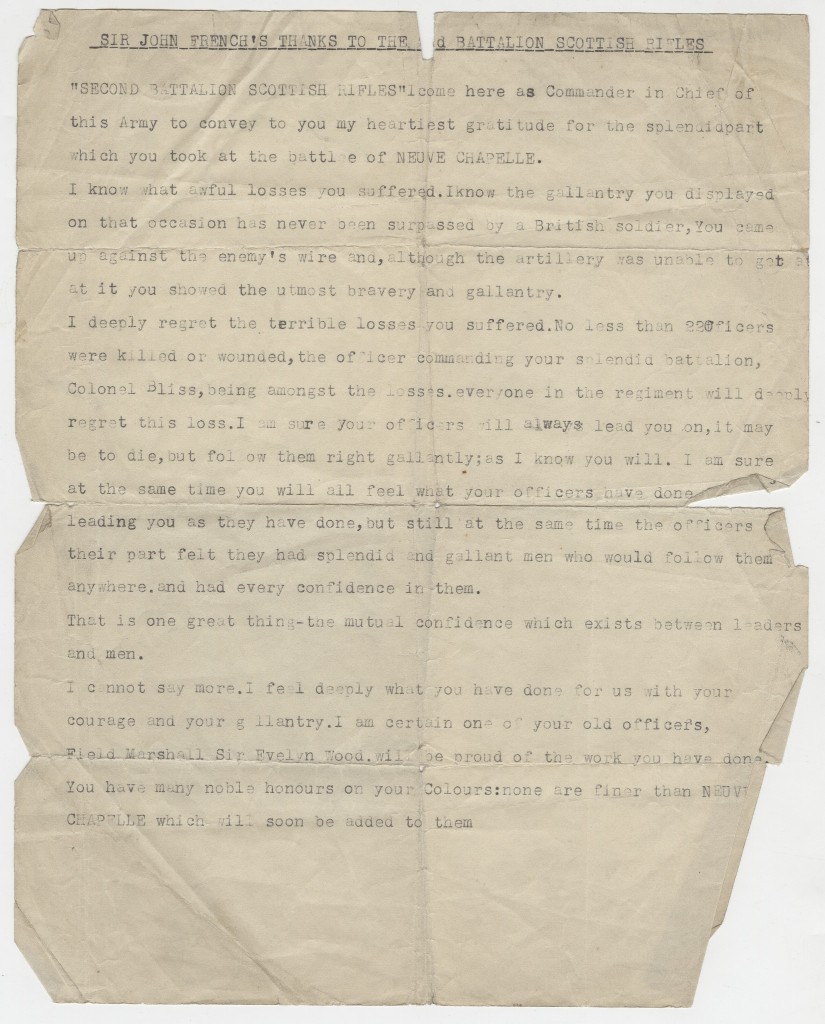
Copy of speech given to 2nd Scottish Rifles by Sir John French following the Battle of Neuve Chapelle
It reads:
“Second Battalion Scottish Rifles – I come here as Commander-in-Chief of the force to express to you my heartiest gratitude for the splendid part which you took in the Battle of NEUVE CHAPELLE in the middle of last month. I know what a terrible time you had – I know what awful losses you suffered. I know the gallantry you displayed on that occasion has never been surpassed by a British soldier. You came up against the enemy’s wire, and although the artillery was unable to get at it you showed the utmost bravery and gallantry.
I deeply regret the terrible losses you suffered on that occasion, 22 officers being killed or wounded. The officer commanding your splendid Battalion, Colonel Bliss, being amongst the losses. Everyone in the regiment will deeply regret this loss. I am sure your officers will always lead you on, it may be to die, but follow them right gallantly; as I know you will. I am sure at the same time you will all feel what your officers have done for you, leading you as they have done, but still at the same time the officers on their part felt they had splendid and gallant men who would follow them anywhere, and had every confidence in them.
That is the one great thing – the mutual confidence which exists between leaders and men.
I cannot say more. I feel deeply what you have done for us by your courage and your gallantry. I am certain one of your old officers, Field Marshal Sir Evelyn Wood, will be proud of the work you have done. You have many noble honours on your Colours: none are finer than NEUVE CHAPELLE which will soon be added to them.”
Between 10th and 14th March, the 2nd Scottish Rifles had 13 officers killed or died of wounds, with a further nine wounded. Only one officer emerged from the battle unscathed, Second Lieutenant W. F. Somervail, who was awarded the Military Cross for his actions during the Battle. Having survived Neuve Chapelle, Somervail was killed only a month before the War ended. From among the rank and file 112 men are recorded in the War Diary as being killed in action, with a further 21 men missing, and 314 men wounded. Included in the rank and file casualties were 29 sergeants or lance sergeants killed or wounded.
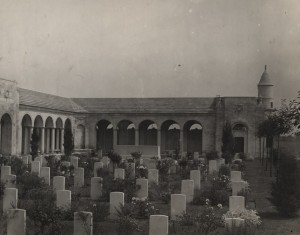
The Le Touret Memorial to the missing c.1934, where many of the men who were killed at Neuve Chapelle are commemorated.
10th March would later become known as Neuve Chapelle day in the Regiment, and was usually marked by a service or parade. In 1928 one of the training platoons of recruits formed at the Regimental Depot at Hamilton Barracks was named Neuve Chapelle Platoon in honour of the part played by the 2nd Scottish Rifles in the Battle.
As Sir John French predicted, NEUVE CHAPELLE would become one of the 10 main battle honours chosen by The Cameronians (Scottish Rifles) to commemorate the Regiments involvement in the First World War.
Comments:
Two pals at War
These photographic postcards show two pals from Glasgow, William Wilson (seated on left) and Alexander Harris (standing on right) during the First World War. Soldiers often had photographs like these taken as souvenirs to send home to their families.
-
-
William (left) and Alexander
-

William and Alexander enlisted into the British Army in November 1914, and were both posted to the 10th Battalion Scottish Rifles. The 10th Battalion was a Service Battalion of The Cameronians (Scottish Rifles), raised as part of Lord Kitchener’s ‘New Army’. On enlistment Alexander was given the regimental number 17097, and William given 17098, suggesting they enlisted together.
In the left photograph, William and Alexander are wearing ill-fitting scarlet jackets; uniform that was largely out of fashion by the time of the First World War. This suggests the image dates to late 1914 or early 1915, when the rapidly expanding army was faced with severe shortages of uniform and equipment resulting in new recruits being issued with old, obsolete uniform from stores. Both men are bare-headed, suggesting that there was no headdress available. The photographer’s negative number, 4798, is recorded in the bottom left corner of the photograph.
An officer of the 9th Scottish Rifles, another battalion of Kitchener’s Army, described the problems faced in clothing and equipping these new battalions:
“We had absolutely nothing in the way of uniform or equipment or anything else. In spite of that we started marching quite soon, as one of the first things to do was to get the men as fit as possible. I think that broomsticks, instead of rifles, were the first equipment that we learnt to drill with. Then a certain amount of uniform started to arrive. This was all old full dress uniform from every kind of unit, and you got a most extraordinary selection on parade. You’d see a man for instance in a rifle tunic and tartan trews, wearing a straw hat, next to somebody else in a red coat and some civilian trousers. At all events the men were clothed – in a way. The next stage was khaki and everybody got fitted out, not so very long after.”
Captain (later Lt-Col) R. M. S. Baynes, quoted in A Tale of Two Captains
In the right photograph, William and Alexander are now wearing khaki Service Dress jackets and trousers, along with Glengarry headdress complete with the cap badge of The Cameronians (Scottish Rifles). Now identifiable as Cameronians, the two friends have a new photograph taken to mark the occasion. They return to the same studio, with the same background as in the first photograph, and adopt similar poses. The negative number on this photograph is 6102.
Dressed in new khaki uniforms, and finally equipped with the correct service rifles, the 10th Scottish Rifles embarked for France on 10th July 1915 on board SS Victoria. They would remain on the Western Front for the duration of the War. Their first real experience of battle was at Loos in September 1915 where, along with the other battalions of the 15th Scottish Division, they would suffer heavy losses.
Alexander Harris was killed in action on 27th January 1916 – the anniversary of the Kaiser’s birthday. The German forces opposite the 10th Scottish Rifles celebrated the Kaiser’s birthday with a heavy bombardment of the British trenches, followed by an attack later that evening. The attack was repulsed but the heavy artillery bombardment resulted in several casualties, Alexander being among them. The whereabouts of Alexander’s grave is unknown, and he is commemorated on the Loos Memorial.
William Wilson survived the First World War. By August 1916 he had been transferred to the 11th Scottish Rifles and served with that battalion in Salonika. At the end of 1918 he was seriously ill with malaria, and was transferred to the Army Reserve on 19th March 1919.
Comments:
Next of Kin: Scottish Families and the Great War – Now open at Low Parks Museum
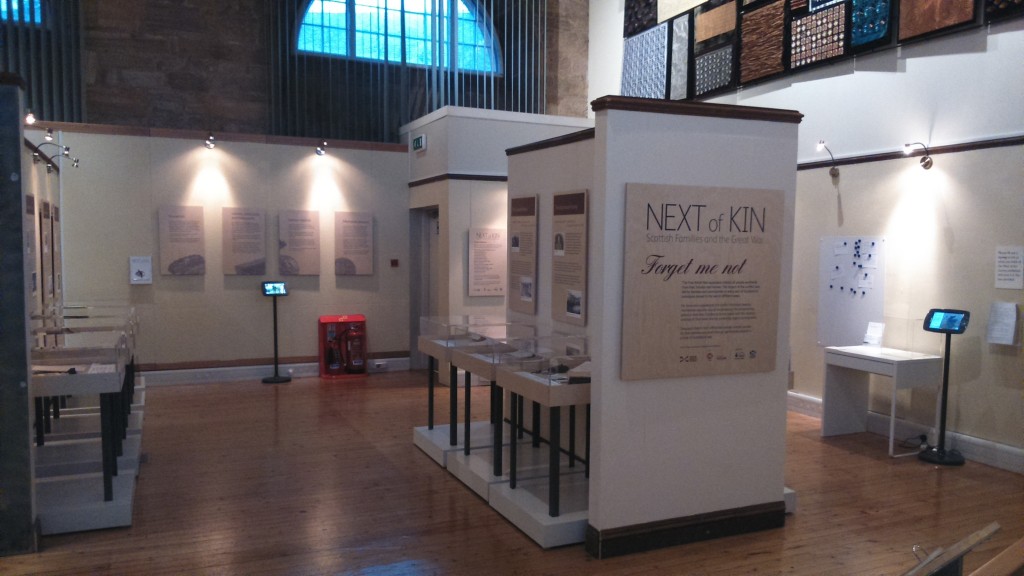
We are very proud to host Next of Kin: Scottish Families and the Great War, now open at Low Parks Museum in Hamilton. Next of Kin was developed by National Museums Scotland in partnership with nine other museums and heritage organisations across Scotland, including South Lanarkshire Leisure and Culture, and was funded by the Heritage Lottery Fund and the Scottish Government.
The exhibition reveals the personal stories of separation and loss experienced by Scottish families and by communities with loved ones who were fighting abroad in the First World War.
In addition to the material on loan from National Museums Scotland, we have used a selection of objects from the museum collection to tell the story of James and David Lusk, members of a local family affected by the War.
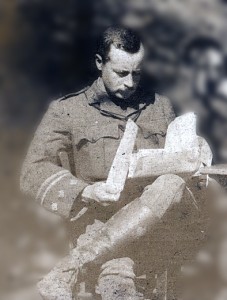
Captain James Lusk, France c.1915
At the outbreak of the First World War, James Lusk was an officer in the 6th Scottish Rifles, one of The Cameronians (Scottish Rifles) four Territorial Force battalions. In civilian life James was a director in the family business, David Colville & Sons iron and steel company. James’s battalion went to France on 21st March 1915.
From the beginning of the War, James wrote extensively to his brother David who was Presbyterian Minister at Oxford University. The letters describe life in the battalion while at their War Station in Falkirk, and active service conditions in France.
Sadly, as with so many family stories from the First World War, tragedy would soon strike. James was fatally wounded on Christmas Day 1915, and died three days later. Possibly inspired by the death of his brother, David Lusk would become a Chaplain to the Forces and serve with the British Army on the Western Front. The exhibition showcases some of the items kept by the Lusk family in memory of James, including his cap badge and identity disc.
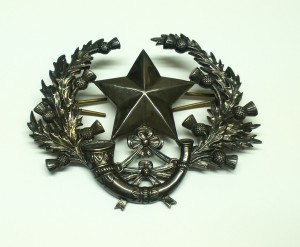
The Cameronians (Scottish Rifles) cap badge, worn by Captain James Lusk
The exhibition also features a selection of wartime newsreel clips of Scottish soldiers, and an audio presentation with spoken extracts from some of the written material that features in the exhibition. There are also two iPad interactives that contain material from partner venues where the exhibition has already been displayed.
The exhibition is open until March 29th and entry is free. Low Parks Museum is open 7 days a week – please do come and visit!
Remember, you can explore more of the museum collection, including more of the James Lusk collection, by using our Online Collections browser.
Comments:
Log in