When one thinks of a military collection, their first thought is an assortment of weapons, medals, uniforms and photographs. Although these objects are an important aspect of a regimental collection, they are far from the only items and stories we preserve and celebrate within our walls and, by no means, the full picture of the Cameronians (Scottish Riffles) military life. Alongside the battles and the acts of heroism we proudly showcase, we are also hosts of hidden human-interest stories that we wish to share with our visitors and blog readers. Sometimes, the simplest items, like a handkerchief, hold the most fascinating tales.
Light-green silk handkerchief, square, with fringing on all edges. Embroidered crest of The Cameronians (Scottish Rifles) in one corner.
When I was looking to update one of our small display cases for February 2025, senior staff members suggested I read in our system about a special handkerchief that was part of our regimental collection and create a display around it and Valentine’s Day. At first glance, this handkerchief appears unimportant and of little interest, but after reading the short description around its donation, I fell in love with it. Within its stiches and threads, a bittersweet teenage love story is woven.
I immediately asked if it would be acceptable to contact the donor, Isabella, and listen to her speak about it, wanting to capture in this post and for my display text a sense of authenticity that I feared was missing from the short description we had recorded before. I was so glad the donor agreed, and we arranged a phone-call. Although a bit hesitant at first, Isabella opened to me very quickly as she tried to sort her emotions and thoughts regarding this handkerchief and why she wished for it to be donated to us. The phrase that she often repeated and stayed with me was that she didn’t want it “to end up destroyed,” after she died.
Isabella received this handkerchief in the 1950s, when she was sixteen years old alongside her last – as far as she remembers – Valentine’s card from a young Cameronian soldier, named Frank. They met at their church’s youth group and soon became good friends allowing for a sweet friendship and innocent love to start between them. A couple of years older than her, Frank left to go to Germany alongside the regiment, but he and Isabella kept in touch and saw each other whenever he visited his family.
When I spoke with Isabella and she narrated to me her story, it was abundantly clear how much she treasured that precious time of her youth. She told me of her very happy memories with Frank and how much she respected and admired his family, who she described as very kind and loving to her.
Her words sounded like the beginning of a sweet love story, and one would expect that what followed this handkerchief was a marriage and happy family life. Isabella didn’t delve into too many details, but she admitted to me that this wasn’t the case for her and Frank. When I asked her why things didn’t progress between them, she told me that she felt she wasn’t “good enough for him” and distanced herself from him and his family. She eventually married a different man, had children and built her own family. But, she was never able to part from the handkerchief, keeping it safe in a pouch alongside other treasured mementos for decades.
She told me that she kept it folded in the pouch as a secret, always afraid that if her first husband found out about it, he would destroy it. A precious and well-guarded secret, she finally took it out of the pouch in her eighties, many years after her first husband’s death, and talked with a hitch in her voice of how afraid she was that it would tear while she handwashed it. She commissioned a frame for it and began to ponder what she wanted to do with it.
Her first thought was to find Frank and speak with him, to attempt to reconnect all these years later so they can reminisce about the past. She enlisted the help of one of her grandchildren and found out that Frank had his own family and was widowed, but she never found the courage to contact him and rekindle their old friendship because she felt “it wasn’t fair.” Unfortunately, she never got the chance to see him again as he died before she changed her mind. Afterwards, she tried to give the handkerchief to his children, but they refused it and she approached Low Parks Museum and offered it as a donation, alongside the frame she had kept it in for the last few years.
It was apparent from the very first time we met her how much she valued and loved this object. She wanted to find a new home for it, where it would continue to be cherished, like she did for over seventy years. She told me how happy she was that we would put the object on display for a few weeks during February and that she would have the chance to travel to Hamilton and see it once again.
(It wasn’t polite … but we soon learned, everyone called Egypt ‘Egg-wiped’.)
Very slowly, we were able to piece together what was happening. The Suez Canal Zone needed 6,000 troops urgently and from Blackbushe Airport, Grahame and I flew to Malta for a meal, and then on to Fayid in Egypt. Egypt was in turmoil and once we had landed, we were enveloped in chaos ! We soon learned the meaning of “Abrogation”; the Egyptians had withdrawn all forms of support for the British Army. King George VI died in London and triggered activities throughout the Canal Zone. Egypt’s King Farouk was unpopular and had severed ties with Britain. Beds were found for five of us in the camp of the Long Range Desert Group; these soldiers ragged us mercilessly and, for three or four days, we just sat on our beds waiting for something to happen.
At last, we transferred to GHQ in Fayid and were allocated a four-man tent.
The camp of tents and ablutions in Fayid, Egypt
By good fortune, the four of us renewed friendships from the Chichester days and swopped ‘group numbers’. Grahame and I were 51-17; we would go home to ‘Blighty’ in 21months time. Louis prepared a monthly demob chart; Tony improvised a method for making ‘chi’ by tapping power from the tent’s light bulb. We established a routine for filling the clay ‘chaguls’ with water, and negotiated a method for obtaining supplies of tea and sugar.
Lewis, Tony & Grahame enjoy a ‘cuppa’
Grahame and I were assigned to shift work in Staff Message Control where a Warrant Officer outlined the routines. Twelve hours on and twelve hours off became our daily habit; we received messages from around the world and distributed them to sections of GHQ. Some were ‘Restricted’ or ‘Secret’ or ‘Top Secret’, but often carried urgency, such as “Priority”, “Operational immediate”, or the dreaded “Flash”! Top Secret and Flash had to be in and out in a matter of seconds.
There was a bonus. We were bound to secrecy but learned what was going on in Egypt and how the army was coping with the unrest and the daily upheavals.
After a night shift, there was also an experience. A walk of two miles took us through a small village by the Sweet Water Canal which had a dreadful smell. Here we were plagued to purchase leather wallets and dubious watches.
The native village near Fayid which bridged the Sweet Water canal
It was, however, the route to a Lido by the Great Bitter Lake, where the army had sunk six barges to create an improvised swimming pool. We took the chance to relax by snoozing, roasting and swimming in the warm water of the Great Bitter Lake.
One way of cooling down – a Stella beer at the Lido
During the summer, the GHQ companies trained hard for the athletic games to be held in the Olympia stadium. My pal Grahame worked hard for the 5,000 metres, whereas my choice was the hop, skip and jump. This I had mastered while at high school, back in Motherwell. When I emerged first, the prize was a small silver cup and a round of drinks in the Naafi.
The author’s winning jump at the Olympia Stadium, Egypt
Trouble escalated in Egypt when General Mohamad Naquib coaxed his Free Army officers to revolt and to overthrow the government. Messages continued non-stop and an “Active Service” category became the rule for troops in the Canal Zone. Britain persuaded the unpopular King Farouk to seek exile in Rome and all the moves before his midnight deadline were noted, recorded and transmitted to London. More messages !
Around 3am, when message traffic paused – time for a snapshot
The pressure abated with a respite of two weeks leave at a very pleasant holiday camp for military personnel in Port Said. On return to work and the shift work regime at Staff Message Control, one event cheered me up. My Rifleman status moved to NCO when I received two stripes … even although the shift system demanded concentration and dedication.
Two stripes and a pause for a photograph
Trouble with the Mau Mau in Kenya created a maelstrom of message traffic. In January 1952, Egypt’s police waged an unnecessary battle with the British army in Ismailia. An RAF aircraftsman was kidnapped in Ismailia, another crisis erupted. Rapid messages passed between London’s War Office and the Middle East Land Forces negotiating his release.
Lewis’s ‘demob chart’ was filling up. It was September; our knees were brown and we packed all the summer clothing and personal effects into our kitbags and waited, and waited. When the call came, we climbed aboard a truck and sang on our way to the airport. Bad news followed. The Anson plane was being repaired but after two years, we were familiar with delays and waiting. So … we waited.
51-17 group on the way to Blighty but stalled at the airport
Eventually the plane managed to reach Malta but needed more repairs. As passengers we bussed to a former monastery in a small town, Mtarfa and told to wait. Of course, we waited … and waited … but once we established there would be no movement each day, we took the local bus service into Valletta.
It was a scramble after six days when news filtered through – “Get ready for departure; a bus is leaving for the airport.” Some hours later we had a meal in Malta then it was homeward bound for Blackbushe airport in Surrey. A coach took us to London and the conversation was kind of sentimental as we viewed ‘the green fields’ on either side of the road. The bus load split up and we all went our different ways.
Somehow, Grahame and I reached Winston Barracks in Lanark. It was a Saturday and the kindly duty Sgt Major welcomed us. “Stuff yer kit in there and report back on Monday morning at nine o’clock,” he said … and we quick marched back to Lanark for the bus.
We were home … but realised that we still faced three and a half service in the Territorial Army.
We are delighted to share with you some memories of National Service, provided by Dr R M Callender. Ron’s military years persuaded him to find a challenging job on return to Civvy Street and he retired as a contented scientist. Ron shares his memories in a three part series, the first of which, titled ‘Dreghorn’, is reproduced below.
Part 1: Dreghorn
The Cameronian ‘sprog’
With a job secured, I left Motherwell’s Dalziel High School looking forward to working near London, which was then hosting the Festival of Britain on the banks of the River Thames.
The posh entrance to Dalziel High School which the author was not allowed to use!
As a schoolboy, my favourite pastime was photography and I learned the hard way !
Ten enjoyable months flitted away and then the envelope arrived. The message was simple – “Please attend the Army Medical Centre in Kingston-on-Thames.” A day of poking, prodding, measuring and questioning followed. “You’re from Lanarkshire ?” the doctor asked, while sticking a thermometer in my mouth. “Put him down for the Cameronians !” Decision made.
My two pals from school who managed to dodge National Service
Days dragged past. Then the second letter arrived … “Report to Dreghorn Barracks on 6th September.” I think I received a postal order that represented the King’s shilling. If I did, I wish I had kept it as a souvenir.
I took a train to Edinburgh, a tram-car to Colington and a saunter in ‘civvies’ to Dreghorn followed. Soon, I became 22584435 for the next four years.
The first day was a nightmare of an issue of denims, a china mug, a ‘KFS set’, complex webbing and heavy boots. A severe haircut followed, in spite of having attended a hairdresser the previous day. When a small group had accumulated we tramped to our ‘billet’, found ‘bed-space’ and hurried into removing all traces of civilian life to the cry of “Outside in five minutes!” In no time at all, we were soldiers in denims, albeit recruits belonging to ‘Auchinleck One’ squad.
As a relief from drill, it was rewarding to have talks and learn of Richard Cameron’s men and how they evolved into Cameronians
It was no surprise to be ridiculed when we stumbled into the mess-hall. Daily we marched to commands on the parade ground, we cleaned our webbing with ‘Blanco’, we stripped down rifles to clean them, and stood to attention when the Last Post was played. Time and again we polished our boots, we walked through the gas chamber, we fired on the range, we had bayonet practice and tackled long marches fully kitted out. Better uniforms evolved one day … and along with my regimental trews, I received the attractive Lowland bonnet and an extra Cameronian badge. Six weeks ended with the passing-out parade and a weekend pass.
Monday morning saw the beginning of ten weeks of special training. As Cameronians, we all knew we were going to Malaya but some mates were destined for Korea, and some for Germany. Just as the jungle training came to an end, I was posted to Chichester Barracks in Sussex for training on how to run a regimental office. After Dreghorn, this was a bit of fun and provided an opportunity to bond and mix with soldiers from other regiments … even although Malaya was seldom out of mind.
By then, I had a ‘mucker’ in Grahame – who became my close friend for 62 years. But a surprise was waiting for Grahame and me on our return to Dreghorn … we were both going to Egypt without delay!
My close friend of 62 years, Grahame (LHS) served as my best man at our wedding in 1958 but sadly died in 2012. I still miss his friendship.
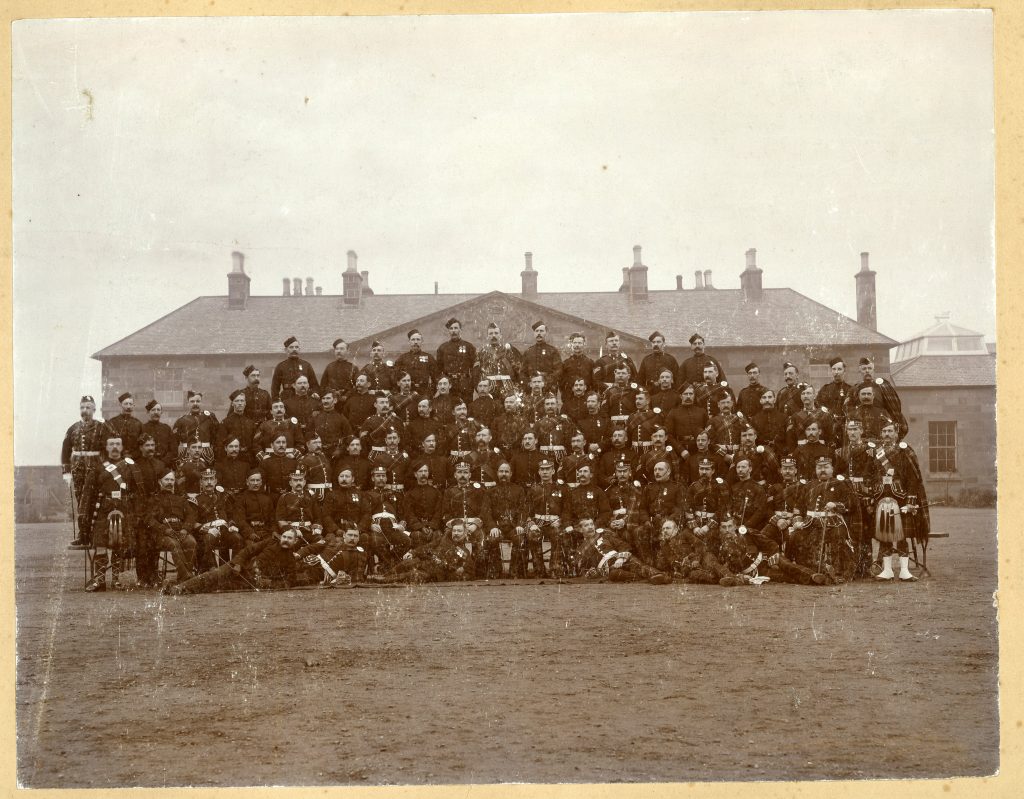
While doing some research on Hamilton Barracks for a forthcoming talk (watch this space!) I came across a couple of photographs in the collection that I hadn’t seen before. They show the Permanent Staff of the Militia Battalions that were stationed at Hamilton Barracks.
Warrant Officers and Non Commissioned Officers of the 3rd and 4th (Militia) Battalions of The Cameronians (Scottish Rifles) and Highland Light Infantry.
The photographs appear to date from the 1890s, and were taken outside the Officers Mess building at the north end of Hamilton Barracks.
Warrant Officers and Non Commissioned Officers of the 3rd and 4th (Militia) Battalions of The Cameronians (Scottish Rifles).
Whenever I come across a ‘new’ photograph I always examine the faces of the men shown in the hopes that I might recognise someone. This can help establish the identity of the unit (if not recorded on the photograph or its catalogue record) and possibly help date the image. Uniform details, such as what medals are worn, or what kind of tartan the Cameronian soldiers are wearing (they didn’t start wearing Douglas tartan until April 1892), can prove useful in narrowing down a time period.
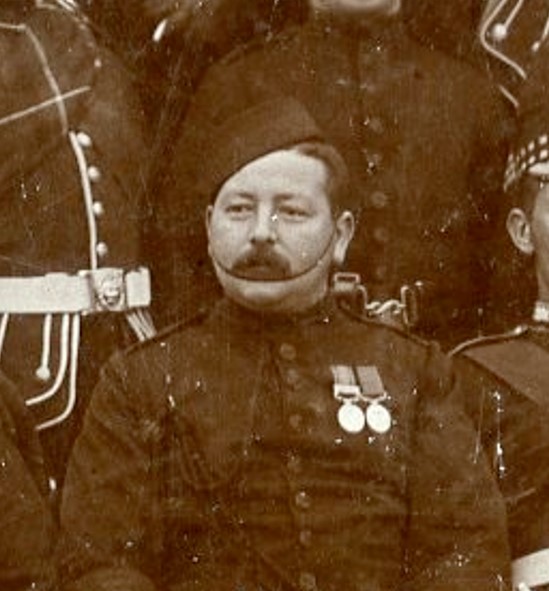
In the first photograph, showing a mix of men from the Cameronians and HLI, I immediately spotted; Pipe Major James Nesbit, (standing on the left, wearing a kilt), Quartermaster Sergeant Tommy Finn (seated fifth from left), Sergeant Major Frederick Brightman (seated centre), and Sergeant Major William Taylor (seated seventh from the right). All of these men had lengthy service with the regular battalions of The Cameronians (Scottish Rifles) before transferring to the Permanent Staff of the militia battalions. In the case of Tommy Finn, he had started his military career as a boy soldier with the 90th (Perthshire) Light Infantry, serving as a bugler to General (later Field Marshal) Evelyn Wood VC during the Zulu War.
Close-up of Tommy Finn, wearing his medal for service in South Africa 1877-79 and the Long Service and Good Conduct Medal. Tommy died in 1921, by which point he was Quartermaster of the 3rd Battalion Cameronians (Scottish Rifles) holding the rank of Major.
Pipe Major Nesbit and Sergeant Major Taylor are both present in the second image, but QMS Finn and Sergeant Major Brightman are missing – suggesting perhaps the photographs weren’t taken at the same time.
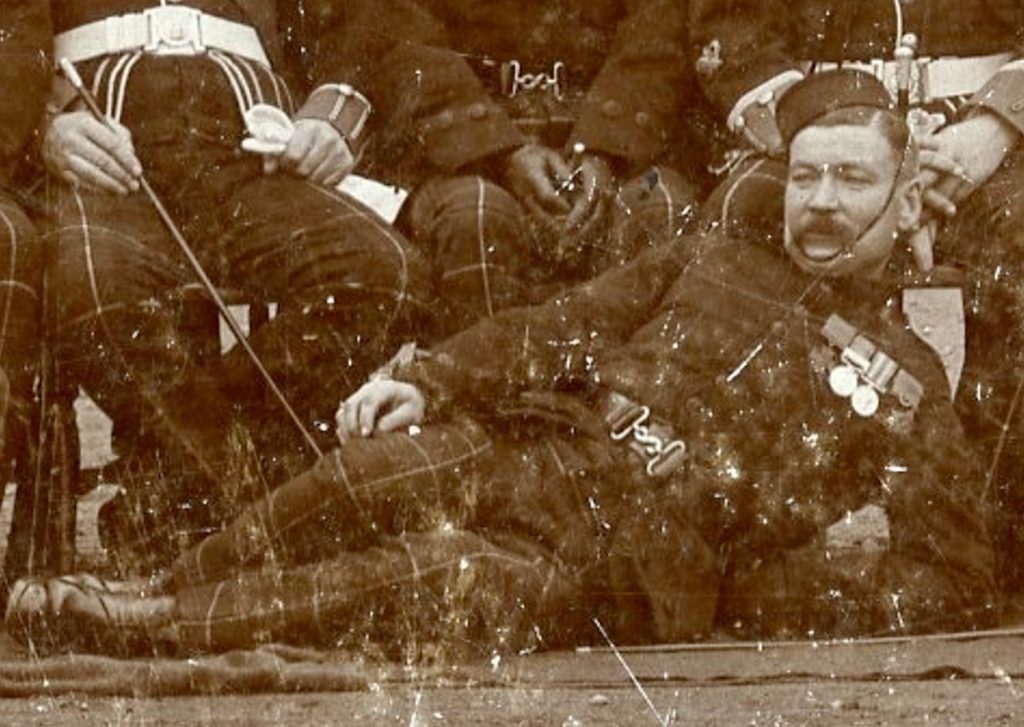
While scrutinising the other faces, my heart almost skipped a beat when I saw the medals proudly worn by one Cameronian soldier…
This soldier is wearing the Victoria Cross – Britain’s highest award for gallantry in the face of the enemy.
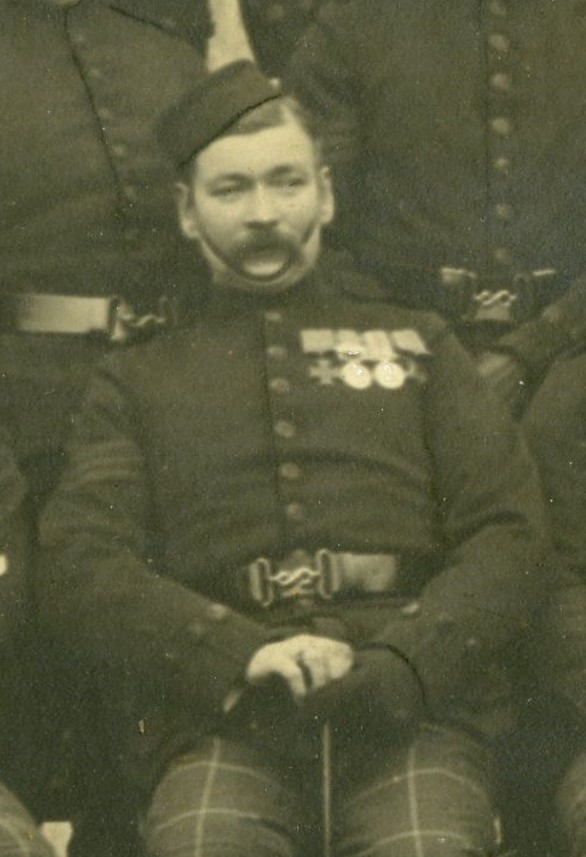
This reclining sergeant is wearing the Victoria Cross, the highest gallantry award awarded to British service personnel for bravery in the face of the enemy. The sergeant, who is also present in the other photograph, is none other than Edmund Fowler VC.
Sergeant Edmund Fowler VC.
Fowler was awarded the Victoria Cross for his actions in South Africa in 1879, while serving as a private soldier in the 90th (Perthshire) Light Infantry, later the 2nd Battalion Scottish Rifles. His citation reads:
On the 28th March, 1879, during the assault of the Inhlobane Mountain, Sir Evelyn Wood ordered the dislodgment of certain Zulus (who were causing the Troops much loss) from strong natural caves commanding the position in which some of the wounded were lying. Some delay occurring in the execution of the orders issued, Captain the Honourable Ronald Campbell, Coldstream Guards, followed by Lieutenant Lysons, Aide-de-Camp, and Private Fowler, ran forward in the most determined manner, and advanced over a mass of fallen boulders, and between walls of rock, which led to a cave in which the enemy lay hidden. It being impossible for two men to walk abreast, the assailants were consequently obliged to keep in single file, and as Captain Campbell was leading, he arrived first at the mouth of the cave, from which the Zulus were firing, and there met his death. Lieutenant Lysons and Private Fowler, who were following close behind him, immediately dashed at the cave, from which led several subterranean passages, and firing into the chasm below, succeeded in forcing the occupants to forsake their stronghold. Lieutenant Lysons remained at the cave’s mouth for some minutes after the attack, during which time Captain Campbell’s body was carried down the slopes.
London Gazette, 7th April 1882
The lieutenant mentioned in the citation was Henry Lysons, also of the 90th (Perthshire) Infantry, and who was also awarded the Victoria Cross for the same action.
Both Fowler’s and Lysons’ medals are in the regimental museum collection, and are on display in Low Parks Museum. I knew from Fowler’s medals that he had later joined the Royal Irish Regiment and had served with them in Egypt, thus qualifying for the 1882 Egypt Medal and Khedive’s Star, but I had no idea that he had returned to the Cameronians (Scottish Rifles) once more, serving on the Permanent Staff of the 3rd (Militia) Battalion. A check of Fowler’s service records (via FindMyPast) gives the following outline of his service:
Joins 90th (Perthshire) Light Infantry on 17th March 1877, with regimental number 1317.
Pays for discharge from 90th at Netley on 29th January 1880, after almost three years of good service.
Re-enlists Royal Irish Regiment on 15th February 1882, with regimental number 373.
Awarded Victoria Cross by Queen Victoria, 13th May 1882.
Transfers to Permanent Staff, 3rd Cameronians (Scottish Rifles) on 16th March 1896, with regimental number 5484.
Promoted Colour Sergeant 14th May 1898
Discharged 13th February 1900, having been found no longer physically fit for active service due to chronic ulcers of the leg.
The information from Fowler’s record can help us narrow down the dates of the photographs even further. As he doesn’t appear to be wearing the rank insignia of a Colour Sergeant in either photograph, they were likely taken between March 1896, when he transfers to the 3rd Battalion, and May 1898, when he is promoted to Colour Sergeant.
I’m always amazed at the stories that are often hidden away in these old photographs, just waiting to be rediscovered.
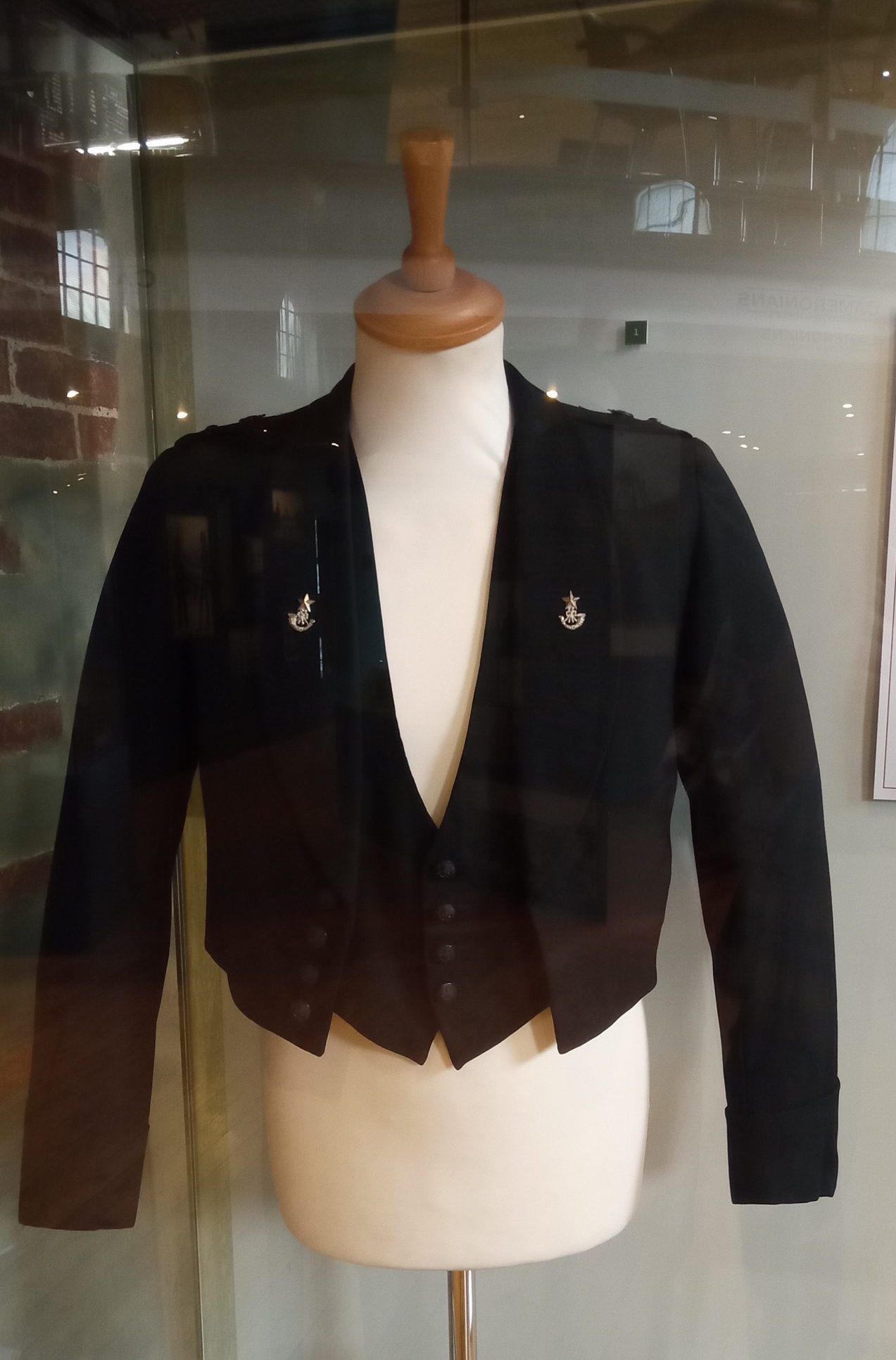
This officers mess jacket and waistcoat belonged to Colonel Thomas Alexander Irvine DSO TD. The uniform was only recently donated to the Museum after it was discovered for sale in an army surplus store in Lanark. Robert Paton, husband of our Collections Manager, Sharon, had been in the surplus store looking for an army greatcoat for a Halloween costume. Robert noticed the uniform (along with matching trews) in the store and on speaking with the owner they discovered Colonel Irvine’s name on the label. Following the discovery, the store owners very kindly offered to donate the uniform to the museum collection.
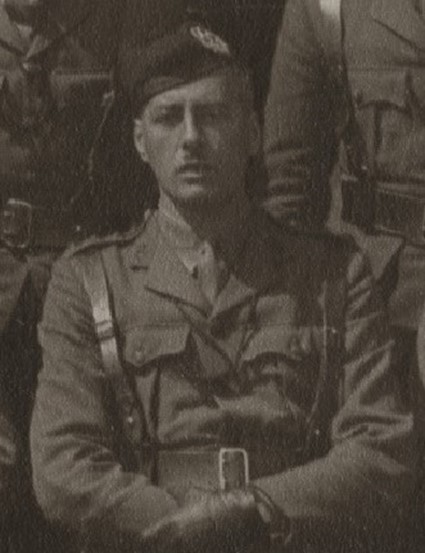
Colonel Irvine, then a Captain, from a group photograph of regimental officers, 1939.
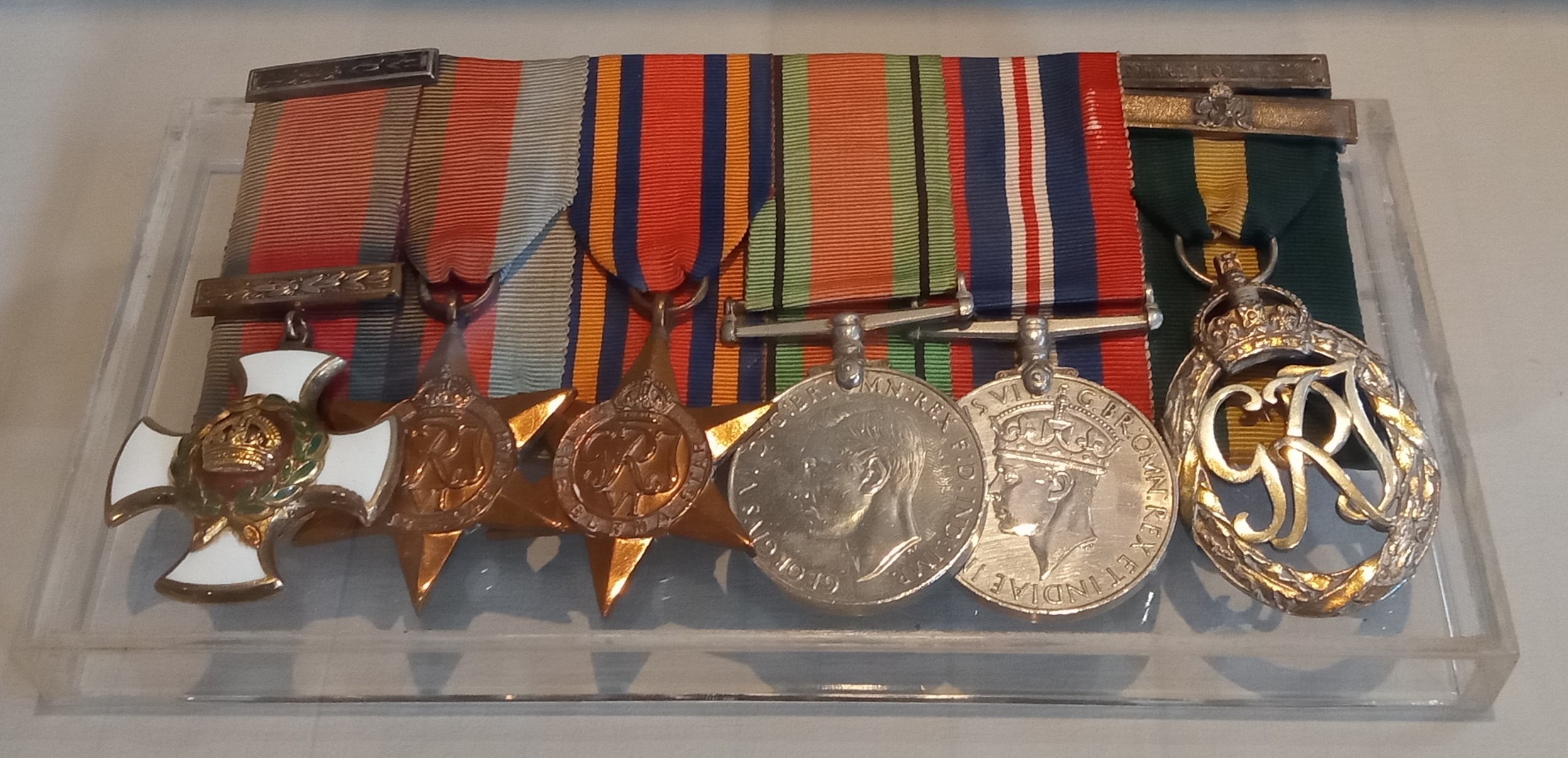
Colonel Irvine, originally from Motherwell, had been living in Symington at the time of his death in 1963. He had attended Hamilton Academy, after which he entered his family’s iron and steel business. Irvine joined the 6th Cameronians as a second lieutenant in 1932. In the early years of the Second World War he was second-in-command of 10th Cameronians, and ultimately commanded the 7th Worcestershire Regiment in Burma. He was awarded the Distinguished Service Order for gallantry in action against the Japanese at the Irrawaddy River in late February 1945. After the War, Colonel Irvine commanded the 6th Cameronians, and was later Commandant of the Lanarkshire County Cadet Force and Chairman of the Territorial Army and Air Force Association in Lanarkshire. Colonel Irvine had been heavily involved in all aspects of regimental life for most of his adult life.
Colonel T. A. Irvine’s medals: left to right – Distinguished Service Order (DSO), 1939-45 Star, Burma Star, Defence Medal, 1939-45 Star, Territorial Efficiency Decoration (TD) with second award clasp.
Colonel Irvine’s uniform has been temporarily displayed in Low Parks Museum, along with his medal group which was already in the museum collection.
The citation for Colonel Irvine’s Distinguished Service Order is worth repeating in full. Originally recommended for the Military Cross (MC), this was upgraded to the DSO by the General Officer Commanding 33rd Indian Corps, Lieutenant-General Montagu Stopford GCB, KBE, DSO, MC.
“This officer commanded 7th Battalion Worcestershire Regiment during the successful establishment of a bridgehead across the Irrawaddy River in the Myittha area on 24/25 Feb ‘45 and during the capture of Ngazun on 26 Feb ‘45.
7th Worcestershire Regiment were ordered to cross West of Myittha during the night 24/25 Feb ‘45, Lt. Col. Irvine led the first flight of his Battalion which met a withering fire, resulting in the majority of boats being sunk. Lt. Col. Irvine’s boat was sunk and he had to swim 400 yards back to the shore. Although practically exhausted, he immediately rallied his whole Battalion and reported to the Brigade Commander for further orders.
On the morning of 26 Feb ‘45, 7th Worcestershire Regiment crossed into the bridgehead previously established by 1st Camerons and were ordered to attack Ngazun in conjunction with 2nd Dorset Regiment.
Lt. Col. Irvine had little time to organise this attack, but he managed to do so in a masterly way. The attack was brilliantly successful. The Battalion, in spite of the set back of the previous night, went into the attack with superb determination, swept through the town, killed many enemy and finally consolidated for the night.
This fine achievement was due almost entirely to Lt. Col. Irvine’s inspired leadership and power of command.”
We are very pleased to have been able to add this fine uniform to a local officer to the museum collection, and would like to thank the owners of Fishing and Survival in Lanark for their generosity in gifting it to us.