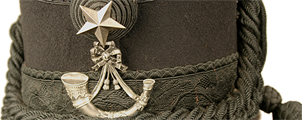
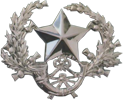
Looking back at soldiers who served in the Cameronians in the early part of the 20th century, one who stands out as an exceptional example is Arthur Christopher Lancelot Stanley -Clarke.
‘Chris’ was born in Brighton on 30th June 1886 and became almost a model of the comic book hero as a young man. He went to Winchester school where he excelled in sports of all kinds, especially cricket and football. Evidence of his sporting skills can be seen in many editions of the Regimental magazine, The Covenanter, more of this later.
His military career began when he was commissioned into the army and in March 1908 joined the 2nd Battalion, Cameronians and he was promoted to Captain early in the war serving in France, and was wounded near Chamigny. Early 1916 he was second in command of the 9th Battalion with the rank of Major and by the end of the year acting Lt Colonel commanding 10th Battalion.
1918 sees him awarded the D.S.O and Bar as well as the French awards of the Legion d’Honneur and the Croix de Guerre. He joined 1st Battalion at the Curragh in 1919 which was an important posting for Stanley-Clarke as it was there he met his future wife.
Between the wars Stanley-Clarke was O.C. at the Regimental Depot, commanded a Battalion of the Royal Scots Fusiliers and in 1937 became a Brigadier commanding the 154th Brigade of the 51st Highland Division.
Back home he took charge of the Lothian and Border area and retired from full service in 1944. He was later awarded the C.B.E and the Polish Polonia Restituta.
A section taken from his Obituary, published in The Covenanter in 1983, written by Lieutenant-General Sir John Evetts, shows how well respected and liked Brigadier Stanley- Clarke was:
A group in late 1920s – A.C.L. centre front
‘He retired from active service in 1944, and moved to Ireland in 1949. Here he became deeply involved in hospital work as Treasurer of a Children’s Hospital, and was for many years on the Board, and latterly Chairman of Mercer’s Hospital in Dublin. He held important positions in the administration of his Church, was an expert gardener, and contributed greatly to animal welfare in Ireland. He died on 8th January 1983, in his 97th year. A man of great charm who never let a friend down and who was loved and respected by all who knew him.’
Also from the Obituary:
‘The following tribute was paid to Brigadier Stanley-Clarke in the history of the 10th Battalion 1914-1918.
“‘The Battalion parted from Lt-Col Stanley Clarke with the sincerest regret. There was no man, who had had the privilege of serving under him who had not felt his influence as a soldier, as a sportsman, and as a gentleman. For more than two years of strenuous active service, his was the outstanding personality that dominated and impressed itself on the Battalion. Officers and men looked up to him in something of the same spirit in which small boys look up to the captain of their school, for there was nothing that they could do which he could not do better. He was an ideal Battalion Commander. On the one hand no detail of routine or of organisation escaped his searching eye, as is borne out by the printed book of detailed Battalion Standing Orders which he issued and which are a model of what such orders should be on active service. On the other hand he was a born athlete, an Oxford Blue, equally pre-eminent as Captain of the regimental football team as leader of his battalion, a genius at leading forlorn hopes, with an amazing faculty for bringing the best out of those whom he led. His presence was like a tonic; the Battalion was devoted to him and would have followed him anywhere. He was a disciplinarian to a degree, but no one was more thoughtful. more considerate, or more loyal to his officers and to his men. Always his men came first. He continued and developed the tradition of the regiment as laid down by Colonel Usher, that, under all circumstances, the first thought of an officer or an NCO must be for his men. And lastly – although it does not come under the category of military history – in his time there was no one fonder of a real healthy ‘rag’ than the C.O. as so many of his company officers fondly remember.”’
Although so highly regarded as a soldier, he would have been remembered just as fondly as a sportsman of high ability.
Group of ex Cameronian soldiers with the then Duke of Hamilton. (Brigadier A.C.L Stanley-Clarke in dark suit standing on far left)
A piece from The Covenanter , Winter 1976 describes his many sporting achievements well:
Football:
‘Joining the 1st Bn. The Cameronians (Scottish Rifles) he quickly made his mark and before being posted to Malta to join the 2nd Battalion, he won his first Army Cap versus the Royal Navy in 1910. Being in Malta and on War Service , undoubtedly deprived him of recognition for some years because it was 1920 before he captained the Army teams against the Royal Air Force and Royal Navy. In 1921, he again captained in those two matches and also, the first post-war International between the British and French Armies. A member of the Army Sports Control Board, he had much to do with its efforts in early years, the results of which have benefitted games and sports in the Army since.’
Cricket
‘Stanley- Clarke’s cricket career was distinguished with many representative matches for the Army in the 1923-24 seasons. The touring teams could always find a place for him when military duties permitted.’
In 1921, the newly-launched “Covenanter ” was enriched with sports news and reports from the 1st Battalion’s Sports Officer at the Curragh. The reports not only gave the scores, etc, but an analysis.
This page from The Covenanter 1921shows his involvement in the cricket match between the 1st Battalion and the Northumberland Fusiliers and the match between Staff and the King’s Shropshire Light Infantry.
Also from The Covenanter Winter 1976
‘Gaining considerable renown as a member of the 2nd Battalion Polo Team in Malta before the outbreak of war in 1914, he later rode to hounds and Point to Point, both here and in Ireland. No “slouch” on the running track, his forte in that field was probably cross-country. One recollects a C- in- C’s Inspection at the Depot when he was commanding there.
The General was visiting the miniature range where he was to talk to the recruits, The following week the Command Recruit’s Cross-Country Run was to be held at Edinburgh and the C-in-C said he had heard the Cameronians expected to win, an expectation he was not surprised to hear of. The last time he had seen our Commanding Officer had been some years before at the British Expeditionary Forces Cross-Country Championships in France, when he, the C.O., had been first man home, Of course, we knew he could play soccer and cricket-we had seen him on both fields, but it was news he could run as well.’
A.C.L Stanley Clarke was a fine soldier, a wonderful sportsman, an exemplary Cameronian and, as was commented on the occasion of his 90th birthday, a particularly modest man.
He wrote a short report of a cricket match, in which he took 4 wickets for 51 runs and made 101 runs batting, and his remarks went as follows:
‘The real weakness of the side has been batting. We caught most sides out pretty cheaply and the fielding has greatly improved, especially the wicket-keeping of Sgt Bugler Gardner. C.S.M Thorn strengthens the batting, and C.Q.M.S. Ayling has the knack of always getting a wicket when he is first put on. The mainstay has, of course been Captain Galloway.’
An Obituary was published in the Wisden Cricketers’ Almanack 1983 ( The ‘Bible’ of cricket)
STANLEY-CLARKE, BRIG. ARTHUR CHRISTOPHER LANCELOT, CBE, DSO, MC, who died at Shiel, Bailey, Dublin, on January 8, 1983, aged 96, was in the Winchester XI in 1905, when he scored 82 not out in the second innings against Eton and headed the batting averages. A solid opening bat, he later played for the Army. At the time of his death he was the oldest living member of I Zingari and, as far as is known, the oldest living English first-class cricketer.
Looking through editions of The Covenanter between the Wars we can discover just what a generally good sportsman A.C.L was! There is a report of a Regimental cross- country race he was running in 1926; he played golf to a high standard, playing for the Depot team in 1928. His football career continued, and an entry shows him appearing for the Cameronians in the Inter Company Competition against the Royal Scots. He is cited as playing doubles in tennis and shown as a fine horseman riding Point-to Point races, including one at Catterick when his horse fell and he re-mounted to finish fifth in the race!
Brigadier Stanley-Clarke and his wife, Olive Carroll-Leahy, were married in 1931. After retirement they moved to Ireland. Olve outlived her husband and died at the age of 100 and was buried in County Cork.
The week beginning 2nd of June was Volunteers Week and we decided to ask one of our long-term volunteers a few questions about his time with us and his work with the Scottish Rifles (Cameronians) regimental collection. Volunteering has a very special place in our regiment’s history as it had a long tradition of brave men who joined the Territorial Army and Volunteer Reserve.
Brandon is a military history enthusiast who is currently studying Social Sciences at New College Lanarkshire. He has done some amazing work for our blog, researching the men behind the medals and it is always a very bright and pleasant day when he comes to our museum.
Our volunteer, Brandon, holding the finished cabinet medal index which he helped create. The display next to him was also created with his help.
Interview:
How long have you been volunteering with us, Brandon?
A year and 3-4 months.
Is this the first time you have volunteered?
Yes.
Why did you decide to volunteer at our museum?
I was on a course, a RISE course, where you get help finding your future plans and, because I was always interested in history, I wanted to look into working with libraries or museums. In the end, I thought museums were the better fit for me.
Had you visited this museum when you were young?
Yes, but when I was very little.
Why did you decide museums were better than libraries?
They have a closer link with military history.
What did you expect volunteering would be like? Was it different than what you thought?
I didn’t really have expectations when I started. It was better than I thought, certainly. The work environment is very good and everyone is very nice. It’s a combination of the collection material and the people who support me that made it a successful experience.
Did you know of the Cameronians (Scottish Riffles) regiment before you began your time with us?
No, but I was always fascinated by military history and knew of other Scottish regiments.
What is your favourite fact about our regiment?
I really like how it is more linked with the working class of Scotland and that the soldiers were often everyday Scottish people who volunteered to take part.
What is your favourite object from the regimental collection?
I really like the military medals. They tell the stories of people who often weren’t officers, but their brave actions granted them the recognition they deserved.
I know that you have always liked military history. Has your perspective on this side of history changed after helping us at the museum for over a year?
I am a lot more appreciative of what the soldiers did. It is a lot more than I ever knew from their beginning. It makes me proud to be Scottish when I learn of all they did and the part they played.
What is your favourite era of our regimental collection?
World war 2 is the most interesting part of the collection. It’s the freshest in my mind. Everything that happened in the western front. You think of all the sacrifices and the people who died and how we have records that commemorate this. And you get to see the changes of the medals from WW1 to WW2. For example, for WW1 medals, the soldiers names were on them but for WW2, this wasn’t the case. I am just fascinated by this change and the possible reasons behind it.
You really find an interesting strand of social history in our collection?
Yes, it is a lot about class. I am fascinated how the same actions would grant different medals to officers and to private soldiers or volunteer soldiers. Class is a big part of medals, in my opinion. Social class is something that I was always interested in because it can divide and separate very easily.
What do you do as part of your volunteering?
Helping with inventory and writing blog posts.
Which is your favourite?
I can’t choose. They go hand in hand for me.
What is the most memorable part of research you did for the collection?
The story of Thomas Scott. His story is really good, and we have letters of him being given the military medal, but he wasn’t alive to receive it. While he was dying, he gave his servant his pocket watch and then the servant possibly returned it because we have it in the museum collection along with other items that relate to Thomas Scott. I just really like that we can see a story through the various objects.
Why do you continue to volunteer?
Because it never gets boring. I am always learning something new about a person or the museum in general. You might do the same thing at times but it never gets boring.
How would you pitch the interest of a regimental/military collection to someone who doesn’t know a lot about this kind of history? What makes it very interesting to you?
The uniqueness of the regimental collection is that we get to examined the people within the regiment in depth. It is almost like a movie and the stuff you read feel unreal, but we know they happened.
What are your future plans?
To work in a museum! Study until I have enough qualifications for a museum to accept me.
Brandon has contributed the following articles for our blog:
This Cameronian is an example of a soldier that served in the First World War with 1st Battalion, but continued as regular beyond 1918 and is an example of a senior soldier, who remained in the Regiment, in this case with 2nd Battalion, in which he rose to the rank of Company Sergeant Major. His long career came to an abrupt end when he died of encephalitis when with the Battalion in Quetta.
Arthur enlisted on 14th June 1905 and above are the two pages of his record; hand -written, not only showing his times home and abroad, but attestation location and personal details, such as occupation at enlistment, family members, address etc. In other words, a synopsis of a career., You will see his line fifth down on both pages. Unlike other soldiers’ records, there are blank columns in the ‘discharge’ section which would prove a mystery, if we didn’t know that Arthur died while serving abroad, and we can look at that later.
This record shows that McMullins was 18 years and two months old when he signed up. This he did in Stratford in London, and in occupation as a labourer. An interesting point to note is that the Cameronians recruited from far afield and not always locally, as some may think.
This valuable document also records he was married to a Martha Elizabeth Darnell and had three children, living in Shoreditch. The date of the marriage was 2nd August 1914 and it is safe to surmise that they decided to wed before Arthur was sent abroad. We can read that he embarked for France on 14th.
Finally, there are details campaigns, awards and any wounds received. We can list McMullins’ campaigns and times at home:
Home 14/6/05 to 18/9/07
India 19/09/07 to 14/12/09
S Africa 15/12/09 to 11/3/12
Home 12/3/12 to 13/8/14
France 14/8/14 to 10/9/16
Home 11/9/16 to 30/7/18
India 10/19 to 1922
Quetta 1922
Kurdistan/ Bagdad Iraq 1923
Quetta 1924
Arthur John McMullins served with the 1st Battalion in WW1, and published in the London Gazette on 10th October 1916 is the announcement of his award of a Military Medal. Usually, the Gazette entries were published two or three months after the relative action. (It took time for the process of recommendation and signatures). We can safely say that his act of gallantry occurred around July/August 1916. Without being too presumptuous, his brave deed could have been during the 1st Battalion involvement in the battle at High Wood. (Citations for bravery are on record for WW2 awards, but most of the citations relating to WW1 actions were destroyed by fire in the 1940s).
What about MucMullins’ previous career pre-WW1?
We know that he joined up in June 1905 and we know that the 1st Battalion was in India at that time and Arthur must have been sent out in 1907 to spend some time before the battalion left India for South Africa in late 1909. The 1st returned to Scotland in March 1912 ( In the1911 census he shows up travelling back with what would be his brother -in -law Edward Darnell, himself in the 1st) and left for war in France in August 1914. What we can’t explain is why Arthur McMullins was home in September 1916. We know that the 1st Battalion moved into trenches at Foncquevilliers on 11th and was deployed with the attacks on the enemy in October. It may be surmised that McMullins had been wounded in the summer and was sent home to recover. There is no evidence for this, but it seems he had little to contribute to the Battalion for the rest of the war.
Looking at the award for Military Medal, it seems that by that time Arthur was a corporal, with 10-11 years’ service. Compared with many of the men he was serving with, he would have been an experienced member of the battalion.
Lieutenant Colonel Richard Oakley was asked to reform the 2nd Battalion in 1919 as they were wanted for service in India then into Quetta 1922.
In 1923 a rebellion took place against Iraq by Kurdish Sheikh Mahmoud with help from Turkey and, as Britain felt responsible for the independence of Iraq a force was mobilised, and the 2nd Battalion joined an expedition to Kurdistan . An extensive account of this appears in The Covenanter in September 1923. They marched 475 miles to Bagdad by 15th May. Soldiers on this campaign received a KURDISTAN clasp to their General Service Medal.
The Battalion returned to Quetta where they spent the next years. There are quite a few references in the Covenanter to sports and shooting matches. A photograph of the ‘C’ Company 1923 boxing team in Bagdad with what is now Company Sergeant Major A. J. McMullins at the front in uniform. Arthur is regularly mentioned in the Covenanter through the 1920s and had become a popular and important figure in the Battalion.
We have in the collection a selection of caricatures of figures of NCO’s and other ranks from 2nd Battalion in 1927. McMullins is shown top right corner.
Arthur John McMullins died in Quetta of encephalitis, a rare condition of the brain, on 18th October 1927 aged just 40. He is buried in Baleli Road Cemetery, Quetta
In The Covenanter of January 1928
‘We regret to announce the death on the 18th October of C.S.M A, ], M’Mullins, from encephalitis, after serving since 1906 with the Regiment and always being exceptionally fit he was noted cross-country runner in his younger days in South Africa. It is sad that he should have succumbed so soon before his time to go home had come. All ‘ B’ Company mourns a most gallant Sergeant Major, and the sympathy of the whole Battalion is extended to his widow and three children in their loss.’
‘2nd Battalion Notes’ and ‘Sergeant Mess Notes’ the following was written
‘ It is with deep regret that we have to announce the death of our very old friend C.S.M McMullins, who was one of our oldest members. Badly as we may feel his loss, there are others who feel it more so, and it is to them, Mrs. McMullins and her children and relatives to whom we extend our deep sympathy in their bereavement and trust their future burden will be in some way lightened’
(C.S.M McMullins is seated second from the left)
Interestingly –from the Covenanter Sept.1928… as a post-script:
C.M.S. McMullins’ eldest son was a pupil of the Queen Victoria School in Dunblane, a school which had, and still does have, links with the Cameronians.
QUEEN VICTORIA SCHOOL. List of boys in above School whose fathers served, or are serving in the Regiment. Bain, J., son of Sergt. A. Bain, 3rd Battalion. Barnes, G., son of C.S.M. G. Barnes. Black, A., son of Pte. A. Black, killed in action, 23/10/16. Brown, J., son of Corpl. J. Brown, 2nd Battalion. Burke, W., son of Sergt. Burke, 1st Battalion., Carroll, W., Carroll, V., sons of Sgt . W. Carroll.. Dunn, V., son of Capt. R. Dunn. . Fyfe, A., son of Pte. A. Fyfe, 2/5th Battalion, died while serving, 3/4/ 1 7. Heron, A., son of Pte. J. Heron, killed in action, 25/9/15. Kitson, W., son of Corpl. A. Kitson. M’Mullins, A., son of C.S.M. A. M’Mullins, 2nd Battalion. Pike, H., Pike R., sons of R.Q.M.S. H. Pike, late 2nd Battalion, Thomson, J., son of Srgt. R. Thomson, 2nd Battalion.
In 1953, National Service slid into a continued service of three and a half years with the Territorial Army. As a Cameronian, it was necessary to answer a call and attend “D Company” at a drill hall in Wishaw. Here, about twenty to thirty men assembled around a good-natured Sergeant who summarised our near future. As he handed out shoulder badges, he explained we were now one small unit of the 264 Scottish Beach Brigade. Somewhat stunned, we formed ranks for a talk by the Officer in Charge, who attempted to explain what it all meant.
Shoulder Badge of ‘264’
At the time, however, it was a bit of a puzzle but it was an attractive badge that had been distributed. The next meeting was to attend the barracks in Hamilton at 2pm, one Saturday. After a morning at work in uniform, the East Kilbride Chieftain bus dropped me off at Hamilton’s ‘top cross’, and a brisk march led to the barracks. This was the Cameronians ‘Head Office’ and seemed to be teeming with soldiers all asking the same question, “What are we doing here ?” Army trucks arrived and the troops clambered on board for a journey through Hamilton to the Chatelherhault High Parks. Recalling the occasion is not easy … it may have been shooting practice. Daylight was going and the trucks ferried everyone back to the barracks in Hamilton.
Life continued in this way with monthly meetings at the Drill Hall in Wishaw and the occasional muster in Hamilton. There was an obligatory summer camp held in the County of Moray; nearby, a convenient bus service travelled to Elgin. In a public house, the barman was shocked when he came to serve us … he remembered us from the Egypt days and was so overcome with emotion that the first round was on the house.
Back in Wishaw, we were briefed on the annual camp for 1954. It would take place in Belgium when the 264 Scottish Beach Brigade would be an important part of Exercise Winch. The journey started with a slow train journey south to a ship waiting in Harwich dock. One singular amusement occurred. During a brief pause at Newcastle station, a few soldiers left the train to search for a cuppa tea. All went well, until that the train departed … and they remained on the platform !
On arriving in Zeebrugge, Belgium, umpteen squads formed up and marched to camps for an allocation of tents … that is, six men to a tent & wait for more instructions. Of course, we waited.
There was activity the following days following a selection of men for duty on the beach, which was like a film set by now. A ship at anchor swarmed with men receiving bulky bundles that descended into amphibious craft, known as DUKWs.
A press cutting explains
Elsewhere, whenever there was space, DUKWs pitched up onto the beach and teams set about unloading the huge bundles for transport to lorries nearby. [Author’s note: Here my memory is hazy but I can recall using short lengths of narrow gauge rails which fitted together so that wheeled trolleys could whisk the heavy packages along the sandy beach. Can any reader verify this ? ]
Commanders meet the Naval Admiral who had overall charge
All went well for a few days. There was variety in the tasks being handed out. Some folks were sea-sick, some DUKWs lost their loads, which floated away until rescued by the Military Police operating from speed boats. Free afternoons that were allocated to Bren gun practice developed into speed challenges. Bets were exchanged but in each race, the duty sergeant failed to beat “Big Ned” who knew the Bren gun backwards.
Larger amphibious craft replaced the DUKWs for large loads
Local tram cars served the holiday resort of Blankenberg and it also was easy to visit the attractive city of Bruges. Our uniforms interested holiday makers … some girls claimed they wanted to practice their English. An ability to speak French also helped to clinch company for the evening.
It was a Thursday. Everything was functioning well. The Beach Brigade was working like a well-oiled machine until an announcement came over the loud speakers set up along the beach. “Return to barracks !”
Loading petered out just as a load was being rescued
In two and threes we walked back to camp while discussing the abrupt message. It was later in the day that the explanation was offered … “There will be no need for a beach brigade in future wars.” [Author’s note : Tell that to the men involved in the Falklands War!]
Back home in ‘Blighty’, good news followed. TA service was to be cut to two years. I had done my time. End of story !
At Question Time in the House of Commons on 2nd November 1954, a summary of our activities summarised the exercise as follows:
Mr. Swingler:
asked the Secretary of State for War to make a statement on the nature of Exercise “Winch”; how many men took part in it; the total cost; why it was held in Belgium; and whether similar exercises will be held in the United Kingdom.
Mr. Head:
This exercise trained 264 Scottish Beach Brigade, Territorial Army, in landing stores across beaches. About 5,000 men, of whom just over 4,000 came from this country, took part. By holding the exercise in Belgium, it was possible for them to handle the normal movement of stores to the British Army of the Rhine, which were diverted through the beaches, so that the exercise cost much less than if an artificial exercise on this scale had been held in this country. The brigade also got valuable experience in working with the Belgian authorities. No similar exercise is contemplated in the near future.
George Anderson, from Leith, was a Riflemen in the 9th Battalion of the Cameronians . He landed in Normandy on the 17th of June 1944. During his time in he was posted in a place called Kleve which is south of Arnhem. Right next to Kleve is the Moyland Forest. . Between the 15th-18th February 1945 his time was employed as a Company runner. This meant that Anderson’s job was to relay messages and information throughout the Company, facing severe danger as a result. The communications within the Company had been cut off due to heavy shelling, and the firing of the enemy automatic weapons, This is why Riflemen Anderson was employed as a runner, as this was the only way for the Company to send messages. There were high casualties and this meant that Anderson was the last remaining runner, therefore he took on all responsibilities that had to do with communication within the Company. Every message that Anderson was given to relay was successfully delivered, despite the heavy shelling from the enemy. Later in March 1945 Anderson would have a deadly encounter with a tank when he and four of his fellow comrades volunteered to try and destroy a German tank that was stopping the whole Battalion from moving forward. Anderson’s four fellows were killed by this tank and George was severely injured as he laid in a field in Germany for four days before he was found by a patrol. Anderson’s injuries were severe as he was missing one leg and had a badly damaged upper thigh on his other leg. For both his actions as a runner and his encounter with the tank ,Anderson was awarded the Military Medal as seen below.
Another responsibility that Anderson took on was that he performed all administration duties for the Company while he was still performing his own duties. The reason George took on these extra responsibilities was due to heavy casualties within Company Headquarters, one of the causalities included the Company Sergeant Major.
Anderson was also well aware of how dangerous his job as a runner was, this is why he handed over some of his personal belongings to his Company Commander just before he went on one of his missions, as he thought he may not return.
The citation for Anderson’s Military Medal states; “He has more than once assumed responsibility far above his rank. His conduct and example through the campaign has been an inspiration to his comrades”
Below is Andersons Citation for the Military Medal he received, detailing his brave actions and diligent service:
Taken form @NationalArchivesTaken form @NationalArchives
After Andersons Military service he started off as a driving instructor; this was fairly shot lived, however, as he would then take on the role of a driver for an engineering company called Bruce Peebles. After his time as a driver, Anderson decided to renew his army links in order to lend his experience as a sergeant instructor at Hamilton Place. After several years of being a sergeant instructor Anderson was then promoted to a storeman in Redford Barracks, which is where he would spend the rest of his working life before retiring and spending time with his wife Betty, whom he married on Christmas Day in 1940. Here are some images of George Anderson:
Later in life Anderson would be presented to the Queen, this unique occasion was captured in a photo that was proudly presented in Georges home: